
How to Calculate ATAR Step by Step
The exact 5-step process your state’s Tertiary Admissions Centre uses to turn your Year 12 raw scores into a final percentile rank.
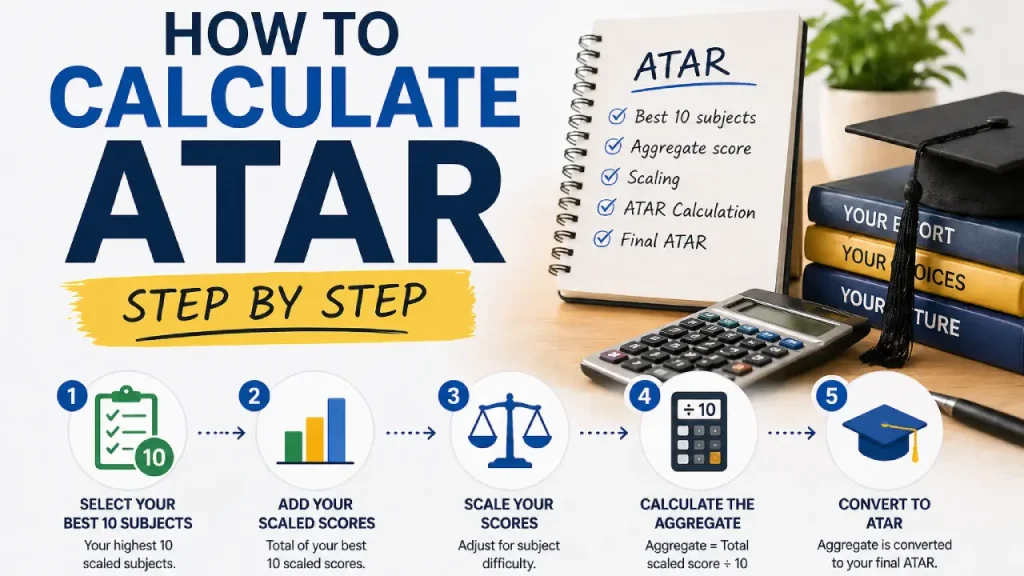
You cannot mathematically calculate your own exact ATAR because the process requires data from every student in your state. However, the TAC calculates it in five steps: (1) combining your school assessments and exam marks, (2) statistically moderating your school marks to match exam performance, (3) applying subject scaling to adjust for subject difficulty, (4) adding up your best scaled scores to form an aggregate, and (5) ranking all aggregates in the state to assign a percentile between 0.00 and 99.95—your ATAR.
What You Need Before Calculating
To understand how the ATAR is calculated, you first need to understand what the ATAR actually is. As we cover in our foundational guide on what the ATAR is in Australia, it is a percentile rank, not a score. The calculation process is designed to figure out exactly where you sit on that percentile line.
The calculation requires two sets of data for every student in the state:
School-Based Assessments (SACs/SATs)
- Assignments, projects, tests, and practicals completed throughout the year.
- Marked by your teachers according to state guidelines.
- These form your “raw school score” for each subject.
External Exams
- The final written exams sat by all students in the state in October/November.
- Marked blindly by official assessors.
- These form your “raw exam score” for each subject.
Step 1: Generate the Raw Scores
The first step is simply gathering the marks. For each subject you study, you will have a raw school score and a raw exam score. In VCE, these are out of 50. In HSC, they are out of 100.
At this stage, your school score and exam score might be wildly different. You might have scored a 42/50 on your school assessments for Physics, but only a 30/50 on the final exam. The TAC cannot use these two mismatched numbers as-is—if they did, students at schools that mark generously would have an unfair advantage over students at strict schools. This brings us to Step 2.
Step 2: Statistical Moderation
Moderation is the process of adjusting your school scores so they align with your exam scores. This is a school-by-school, subject-by-subject calculation.
Here is how it works conceptually:
They compare the spread of your school’s internal SAC marks against the spread of that same group’s external exam marks.
If your school’s SAC marks are generally 5 points higher than how those same students performed on the exam, the TAC applies a downward adjustment curve to everyone’s SACs.
Your raw SAC score is moved up or down the curve based on where you sit relative to your classmates. Your rank within your school cohort is preserved, but the absolute numbers change.
After moderation, a student who got a 40 SAC at a strict school and a 30 on the exam is treated exactly the same as a student who got a 50 SAC at a lenient school and a 30 on the exam. Your teacher’s marking style no longer matters—only your relative performance within your class and your class’s actual exam performance matter.
Step 3: Subject Scaling
After moderation, you have a single, fair “Study Score” for each subject. But the TAC still isn’t done. They now need to apply scaling.
Scaling adjusts scores based on the academic strength of the students taking that subject across the whole state. This is the step that has the biggest impact on your final ATAR. For a deep dive into the mathematics behind this, read our full explanation of how ATAR scaling works in Australia.
High-Scaling Subjects (Scales UP)
- Specialist Maths, Maths Methods, Physics, Chemistry.
- Why? Because the students taking these subjects tend to score highly across all their subjects. The statistical model assumes these subjects were more difficult and lifts the scores.
- A raw 30 in Specialist Maths might become a scaled 35+.
Low-Scaling Subjects (Scales DOWN)
- Standard English, Business Management, Health & Human Dev.
- Why? Because the overall academic performance of the students taking these subjects is closer to the state average. The model adjusts the scores down to maintain fairness.
- A raw 35 in a low-scaling subject might become a scaled 30.
Scaling is applied to the score, not the student. If you score in the top 5% of the state in a low-scaling subject, your scaled score will still be very high—higher than a student who scores in the bottom 20% of a high-scaling subject. Your raw performance always comes first; scaling just provides a secondary adjustment.
Step 4: Calculate the Aggregate
Now you have a “Scaled Score” for every subject. The TAC adds these together to create your aggregate. However, they don’t just add up all your subjects equally—each state has specific rules about which subjects count and how much they count.
Note: English must be one of your top 4. The 5th and 6th subjects contribute a smaller amount to prevent students from gaming the system with extra subjects.
Note: You must complete at least 10 units. Only your best 10 units count. If you do 12 units, your worst 2 units are dropped entirely.
Note: Queensland recently transitioned from OP to ATAR. For a detailed breakdown of how QCE results convert to ATARs, see our guide on QCE ATAR requirements.
Step 5: Convert to a Percentile Rank
This is the final, defining step. The TAC now has an aggregate score for every eligible Year 12 student in the state—tens of thousands of numbers.
They sort every student from highest aggregate to lowest aggregate. Then, they assign the ATAR:
- The student with the highest aggregate receives an ATAR of 99.95.
- The system works down the list in increments of 0.05.
- If you are at the exact point where 75% of students are below you, your ATAR is 75.00.
- The lowest aggregate that qualifies for an ATAR typically sits around 30.00. Below that, no ATAR is issued.
Your ATAR is literally your percentage position in the state. For a more detailed explanation of this conceptual leap, revisit our guide on what the ATAR is.
Putting It Together: A Worked Example
Let’s trace a hypothetical VCE student—let’s call him Alex—through the calculation to see how the numbers transform at each step.
English: SAC 38, Exam 34. Maths Methods: SAC 40, Exam 35. Chemistry: SAC 42, Exam 38. Biology: SAC 36, Exam 35. Physics: SAC 30, Exam 28.
The school marked slightly hard in English and Methods, but leniently in Chemistry. After moderation, Alex’s scores are adjusted to match the exam curve: English 34, Methods 35, Chemistry 37, Biology 35, Physics 28.
Scaling is applied. English (low scaling) drops to 32. Methods (high scaling) jumps to 39. Chemistry (high scaling) jumps to 41. Biology (mid scaling) stays at 34. Physics (high scaling) jumps to 32.
Top 4: English (32) + Methods (39) + Chemistry (41) + Biology (34) = 146. Plus 10% of 5th (Physics: 32 × 0.10 = 3.2). Total Aggregate = 149.2.
An aggregate of 149.2 in Victoria typically places a student around the 92nd percentile. Alex’s ATAR is 92.00.
Alex’s raw school marks looked good (mostly high 30s and low 40s out of 50). But after moderation (which brought them down to match exams) and scaling (which shifted them based on subject difficulty), the final numbers changed significantly. This is why you should never try to calculate your ATAR from your school report alone.
How to Estimate Your Own ATAR
Since you cannot run the state-wide moderation and scaling algorithms yourself, the only way to estimate your ATAR is to use the previous year’s scaling data in an ATAR calculator.
Collect your most recent SAC marks and your marks from any practice exams. If you don’t have exam marks yet, estimate them based on your SAC performance minus 3–5 points (most students score slightly lower on exams than on SACs).
Use a reliable, up-to-date ATAR calculator. Input your raw scores for each subject. The calculator will apply last year’s official scaling tables to estimate your scaled scores.
The calculator adds up your best scaled scores according to your state’s rules (e.g., top 4 + 10% of 5th/6th in VCE).
The calculator matches your estimated aggregate against the previous year’s aggregate-to-ATAR percentile table to give you a predicted ATAR.
Scaling data changes every year based on the specific cohort. To be safe, assume your real ATAR will be 1–2 points lower than the calculator estimates. Use the lower number when planning your university preferences.
What If the Calculated Number Is Low?
If you run your numbers through the estimation process and the result is lower than you need for your dream course, don’t panic. The calculation process reveals something critically important: your ATAR is not fixed until December. You still have time to influence the raw scores that feed into it.
If your estimated ATAR is coming out in the 50–65 range, you have access to an enormous number of excellent university courses. Many students fixate on 80+ ATARs without realising that rewarding, well-paid careers in fields like nursing, IT, design, and education are readily available with mid-range ATARs.
If you are still in Year 11 or early Year 12, look at your subject lineup. Are you taking at least two high-scaling subjects (Methods, Chemistry, Physics)? If not, and you are capable of handling them, switching subjects is the single most impactful thing you can do to shift your aggregate upward before the calculation even runs.
Frequently Asked Questions
Key Takeaways
- The ATAR is calculated in five distinct steps: Raw scores → Statistical moderation → Subject scaling → Aggregate calculation → Percentile ranking.
- Moderation fixes school-level unfairness. It mathematically aligns your internal school marks with how your specific school cohort performs on the external exams.
- Scaling fixes subject-level unfairness. It adjusts scores based on the academic strength of the entire state’s cohort in that subject, ensuring a high mark in a difficult subject isn’t treated equally to a high mark in an easy subject.
- The aggregate has specific rules. You cannot just add up all your subjects. Each state has rules about which subjects count (e.g., English must be included, 5th/6th subjects count for less).
- You cannot calculate your exact ATAR, but you can estimate it closely by applying last year’s official scaling data to your raw scores using an ATAR calculator—then subtracting 1–2 points for annual variance.
- Understanding this process gives you a strategic advantage. Knowing that scaling exists allows you to choose subjects that will mathematically maximize your aggregate.