When Are ATARs Released in 2026? Exact Dates for Every State
The definitive timeline for ATAR release dates, university offer rounds, and what to do if the numbers don’t go your way.
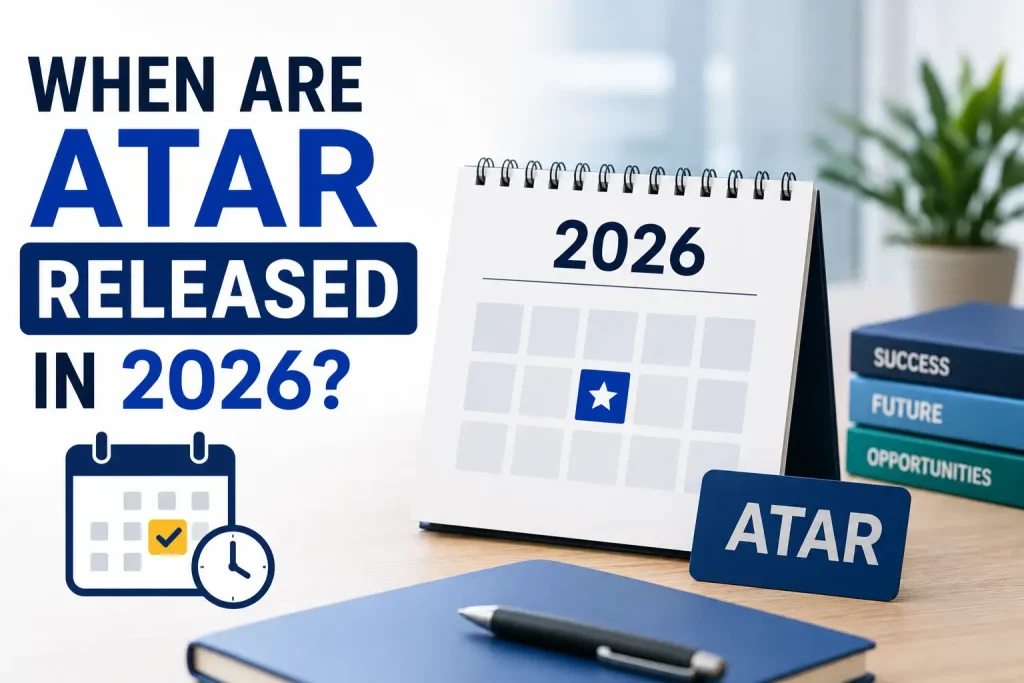
This question has two answers depending on when you finish Year 12. If you are finishing Year 12 in 2025 to start university in 2026, your ATAR will be released in December 2025 (typically between December 12 and December 20, depending on your state). If you are currently in Year 10 or 11 and will finish Year 12 in 2026, your ATAR will be released in December 2026 (following a similar mid-December timetable). ATARs are never released during the year—always in mid-December, once all exams are marked and the complex VCE and HSC scaling processes are complete.
The Year-Over-Year Confusion (Clarified)
When students search “When are ATARs released in 2026?”, they are usually caught in a very specific naming trap. The Australian school year runs from February to December. This means:
- Students finishing Year 12 in late 2025 receive their ATARs in December 2025 and use them to apply for university courses that start in 2026.
- Students finishing Year 12 in late 2026 receive their ATARs in December 2026 and use them to apply for university courses that start in 2027.
There is no ATAR release event during the calendar year of 2026 itself. All ATARs are released in December, at the very end of the academic year they were earned. Below, we have provided the exact dates for both scenarios so you have the information you need, regardless of which year you are in.
Exact ATAR Release Dates: December 2025 (For 2026 Uni Entry)
If you are in Year 12 right now (2025), these are the dates you need to mark on your calendar. Each state’s Tertiary Admissions Centre (TAC) operates on a slightly different schedule. Note: TACs finalise these specific dates in the middle of the year, so always verify on your state’s portal, but historically they fall rigidly into these windows.
| State / Territory | TAC Portal | Projected Release Date | Day of Week |
|---|---|---|---|
| Victoria | VTAC | ~Dec 12, 2025 | Friday |
| Queensland | QTAC | ~Dec 14 or 15, 2025 | Sun / Mon |
| South Australia / NT | SATAC | ~Dec 17, 2025 | Wednesday |
| Western Australia | TISC | ~Dec 18, 2025 | Thursday |
| NSW / ACT | UAC | ~Dec 18 or 19, 2025 | Thu / Fri |
| Tasmania | UTAS Direct | ~Dec 17, 2025 | Wednesday |
Historically, VTAC and UAC release ATARs at exactly 7:00 AM local time. QTAC is often 9:00 AM AEST. SATAC and TISC typically fall between 8:00 AM and 9:00 AM. Set multiple alarms, but more importantly, ensure you have successfully logged into your TAC portal the night before. Server crashes at 7:01 AM are a tradition—having the tab open and refreshed helps.
Projected ATAR Release Dates: December 2026 (For 2027 Uni Entry)
If you are in Year 10 or 11 in 2025 and will be sitting your final exams in 2026, your ATAR will be released in December 2026. Because the academic calendar shifts slightly each year, the exact days of the week will change, but the mid-December window remains absolute.
| State / Territory | TAC Portal | Projected Release Window | Likely Day of Week |
|---|---|---|---|
| Victoria | VTAC | Dec 11 – 13, 2026 | Friday |
| NSW / ACT | UAC | Dec 17 – 18, 2026 | Thursday |
| Queensland | QTAC | Dec 13 – 14, 2026 | Sunday |
| WA / SA / NT / TAS | TISC / SATAC / UTAS | Dec 16 – 18, 2026 | Wed – Fri |
Tertiary Admissions Centres officially confirm the specific date and time in the middle of the exam year (around July–August). They do this because the marking and statistical scaling process must be fully completed before they can guarantee a release window. Bookmark this page and check back in August 2026—we will update these tables the moment the TACs make their official announcements.
University Offer Rounds for 2026 Entry
Getting your ATAR is only step one. The day that truly changes your life is the day you receive a university offer. If you are entering university in 2026, here is how the offer timeline works after you get your ATAR in December 2025.
After you see your ATAR, you have a very short window (usually 3–5 days) to log into your TAC portal and reorder your university preferences based on your actual score. This is the most critical administrative task you will ever do.
Some TACs run an early or “December Round” of offers. These are typically for international students, students who accepted early entry schemes, or applicants to courses with very low demand. Most domestic school-leavers do not receive offers in this round.
This is the big one. For 2026 entry, the VTAC Main Round, UAC Main Round, and QTAC Major Round typically fall between January 14 and January 16, 2026. The vast majority of school-leaver offers are made in this round. You will receive an email and/or a status update on your TAC portal.
If you miss out in the Main Round, don’t despair. There are usually 2–3 more offer rounds in late January and early February as students who received offers decline them, freeing up places. Courses that missed their quotas will dip into the waiting list.
What Happens Before Release Day?
Understanding the timeline before December helps manage anxiety. Your ATAR doesn’t magically appear—it is the output of a massive, highly coordinated logistical operation.
You sit your final written exams. For VCE students, this runs from early October to mid-November. For HSC students, it’s mid-October to early November.
Thousands of teachers are locked in marking centres across the country. Exams are marked blindly (the marker doesn’t know whose paper it is). This takes 2–3 weeks.
Your raw exam scores are combined with your school-based assessment scores (SACs in VCE, school assessments in other states). Then, the complex scaling algorithm is applied. Scaling adjusts your scores based on the strength of the cohort in each subject. If you want to understand exactly how this math works, read our comprehensive VCE scaling guide. This process takes about a week.
The TAC takes your scaled study scores (or equivalent in other states), adds them together to form an aggregate, and then ranks that aggregate against every other student in the state. That ranking is converted to a percentile between 0.00 and 99.95 — your ATAR.
How to Prepare for Results Morning
Results morning is emotionally intense regardless of what number you get. A little preparation goes a long way toward making the experience manageable rather than chaotic.
The Night Before
- Log into your TAC portal (VTAC/UAC/QTAC) and ensure your password works
- Have your student number and TAC ID written down on a piece of paper
- Close unnecessary browser tabs—the TAC websites will be under immense load
- Decide who you want to be with when you see the number (family, alone, friends?)
- Have a backup plan ready: if your ATAR is 10 points lower than expected, what is your first move?
The Morning Of
- Don’t refresh the page obsessively from 6:00 AM—it won’t load early and you’ll just spike your anxiety
- Open the portal at 6:55 AM and wait calmly
- When the number appears, screenshot it immediately (portals sometimes crash in the first 10 minutes)
- Before you react emotionally, open a second tab and look at the previous year’s course cutoffs to contextualise your score
- Remember: your ATAR is a rank, not a measure of your worth, intelligence, or future success
Use an ATAR calculator or your TAC’s course search tool to immediately map your ATAR against the courses you’re interested in. Don’t guess whether your score is “good enough.” Look at the actual 2024/2025 clearly-in ATARs for your preferred courses and compare them directly to your number. This grounds you in data rather than emotion.
What to Do If Your ATAR Is Lower Than Expected
This is the section you should read even if you’re confident you’ll get a high ATAR—because overconfidence is a risky strategy, and knowing your backup options reduces anxiety.
If your ATAR comes in below the clearly-in score for your dream course, you have three immediate options:
Just because you miss out in the January Main Round doesn’t mean you won’t get an offer. Cutoffs often drop by 1–5 points in subsequent rounds as places open up. Keep the course as your first preference. If the clearly-in was 80 in the Main Round, it might drop to 76 in Round 2.
If you wanted Bachelor of Psychology (ATAR 80) but got 70, switch your first preference to Bachelor of Psychological Science (ATAR 65) at the same university. You can often transfer between related degrees after your first year. This is one of the most reliable strategies in the Australian university system.
If your ATAR is significantly below university entry levels, you are not locked out. TAFE diplomas, foundation studies, and enabling programs exist specifically for this scenario. Many students who receive low ATARs end up graduating from the exact same universities—and in the exact same degrees—as students who received 95+ ATARs. They just took a slightly longer route.
To see every available option—from TAFE articulation to mature-age entry and special admission schemes—read our complete breakdown of alternative pathways to university in Australia.
If you are reading this and you are not yet in Year 12, the single most impactful thing you can do right now to avoid a disappointing ATAR is optimise your subject combination. Choosing subjects that scale well—without overcommitting to subjects you can’t handle—is the most reliable way to add 3–5 points to your final result. If you haven’t mapped out your strategy yet, our guide to the best subjects for a high ATAR in Australia is the place to start.
Frequently Asked Questions
Key Takeaways
- There is no ATAR release “in” 2026. If you want to start uni in 2026, your ATAR is released in December 2025. If you finish Year 12 in 2026, your ATAR is released in December 2026.
- Release dates vary by state. Victoria is typically first (around Dec 12), with NSW, WA, and SA/NT following a few days later (around Dec 17–19).
- Release time is early morning. Expect your ATAR to appear on your TAC portal between 7:00 AM and 9:00 AM local time. Have your login details ready the night before.
- University offers come later. For 2026 entry, the main round of offers lands in mid-January 2026 (around Jan 14–16). You have a short window after getting your ATAR to reorder your preferences.
- A lower-than-expected ATAR is not the end. Subsequent offer rounds, course transfers, and alternative pathways mean that your ATAR is a starting point, not a final destination.
- Preparation reduces anxiety. Screenshot your ATAR immediately, map it against real course cutoffs using an ATAR calculator, and have a backup plan ready before results morning.
Disclaimer: The ATAR release dates and university offer round dates published in this article are projections based on historical data from VTAC, UAC, QTAC, SATAC, TISC, and UTAS. Tertiary Admissions Centres officially confirm exact dates mid-year. While these projected dates are highly reliable, they are not guaranteed until formally announced by your state’s TAC. Always verify official dates directly on your TAC’s website. This article does not constitute official admissions advice.