What ATAR Do I Need for Paramedicine?
The complete guide to the ATAR for Paramedicine in Australia — including why some cutoffs are artificially inflated, which universities offer the best value, and the non-academic requirements that actually determine if you get the job.
The ATAR for Paramedicine in Australia typically ranges from 60.00 to 95.00. The massive 35-point gap exists because elite universities like Monash and the University of Sydney have inflated ATARs of 90–95 due to students using the degree as a pre-medicine backdoor. In reality, the core academic requirement to be a paramedic is much lower. Regional and mid-tier universities like CSU, UniSA, and QUT offer fully accredited paramedicine degrees with ATARs between 60.00 and 85.00. Furthermore, ambulance services do not care what ATAR you got—they only care that your degree is accredited and that you have a driver’s license.
The Pre-Med Anomaly: Why Some ATARs Are 90+
If you look up the ATAR for Paramedicine at Monash University or the University of Sydney, you’ll see numbers around 93 to 95. This gives many students the false impression that you need to be in the top 5% of the state to become a paramedic. You don’t.
This anomaly is caused by the exact same market forces that inflate the ATAR for Biomedical Science. High-achieving students who miss out on direct medicine entry—but who don’t want to face the extreme competition of a generic science degree—flock to paramedicine at prestigious universities. They aren’t there because they want to be paramedics; they are there because they want to use the degree as a stepping stone to graduate medicine, or because their parents told them to pick a “health degree” at a Group of Eight university.
If your genuine goal is to work as a paramedic, paying for a 95-ATAR degree at a Go8 university is a waste of money and effort. You will learn the exact same clinical skills, sit the same national registration exam, and apply for the exact same ambulance jobs as a graduate from a 65-ATAR university. The only difference is your HECS debt and the stress you endured to get the higher ATAR.
ATAR Requirements by University — NSW & ACT
NSW highlights the ATAR divide perfectly. The University of Sydney is massively inflated, while Western Sydney University and Charles Sturt University offer much more accessible, equally accredited pathways.
| University | Degree | Indicative ATAR | Notes |
|---|---|---|---|
| University of Sydney | BBachelor of Paramedicine | ~90.00–95.00 | Artificially inflated by pre-med demand. Same qualification as lower-ATAR options. |
| Western Sydney Uni | BParamedicine | ~80.00 | Excellent practical program. Strong relationships with NSW Ambulance. |
| CSU (Port Macquarie) | BParamedicine | ~70.00 | Highly respected by industry. Strong rural and regional focus. |
| CSU (Bathurst) | BParamedicine | ~68.00 | Great campus facilities, including simulation labs. |
| ACU (North Sydney) | BParamedicine | ~78.00 | Strong clinical placement network. Good metro access. |
ATAR Requirements by University — Victoria
Victoria is home to Monash, which sets the national benchmark for inflated paramedicine ATARs. However, Victoria University and Australian Catholic University offer brilliant alternatives for students who actually want to work on ambulances without the elite-university price tag.
| University | Degree | Indicative ATAR | Notes |
|---|---|---|---|
| Monash | BParamedicine | ~93.00–95.00 | Highest ATAR for paramedicine in Australia. Heavily pre-med driven. |
| ACU (Melbourne) | BParamedicine | ~75.00 | Highly regarded by Ambulance Victoria. Excellent placements. |
| Victoria Uni | BParamedicine | ~65.00 | One of the most accessible pathways in metro Melbourne. Great value. |
| Federation Uni | BParamedicine | ~60.00 | Very low ATAR. Ideal for regional students wanting to work in rural VIC. |
ATAR Requirements by University — Queensland
Queensland offers a very sensible middle ground for the ATAR for Paramedicine. QUT is the standout provider here, offering a rigorous, well-respected program without the extreme Go8 inflation seen in NSW and Victoria.
| University | Degree | Indicative ATAR | Notes |
|---|---|---|---|
| QUT | BParamedicine | ~82.00–85.00 | QLD’s premier program. Highly competitive for Queensland Ambulance Service jobs. |
| USC | BParamedicine | ~70.00 | Strong regional focus. Excellent facilities on the Sunshine Coast. |
| CQUni | BParamedicine | ~65.00 | Widely accessible across regional QLD campuses. |
| JCU | BParamedicine | ~68.00 | Unique focus on tropical, rural, and remote paramedicine. |
ATAR Requirements by University — WA, SA & TAS
These states offer some of the most accessible and strategically sound options in the country. Edith Cowan University in WA and UniSA in SA are major suppliers of graduates to their respective state ambulance services.
| University | Degree | Indicative ATAR | Notes |
|---|---|---|---|
| ECU (WA) | BParamedicine | ~70.00 | WA’s primary provider. Excellent employment rates with St John WA. |
| Murdoch (WA) | BParamedicine | ~65.00 | Very accessible entry. Strong community focus. |
| UniSA | BParamedicine | ~68.00 | SA’s leading program. Direct pipeline to SA Ambulance Service. |
| Flinders | BParamedicine | ~70.00 | Strong rural health focus integrated into the degree. |
| UTAS | BParamedicine | ~65.00 | Tasmania’s only provider. Essential for staffing Ambulance Tasmania. |
Prerequisites and the “Hidden” Requirements
The academic prerequisites for paramedicine are surprisingly flexible compared to other health degrees. You don’t need the heavy physics and maths requirements demanded by degrees like radiography, nor do you need the brutal 99+ ATAR required for direct entry into programs like the University of Adelaide’s medicine program. However, there are non-academic hurdles that will stop you from working faster than a low ATAR will.
| Subject / Requirement | Status | Details |
|---|---|---|
| English | Mandatory (All) | Standard across all universities. Required for clinical documentation. |
| Biology | Assumed / Recommended | Highly recommended for anatomy and physiology units. |
| Mathematics | Varies (None to Methods) | Some unis require Methods, others accept General Maths, others have no maths prerequisite. |
| Driver’s License | Mandatory for Employment | You cannot be employed as a paramedic without a valid, unrestricted driver’s license. A manual license is strongly preferred. |
| Physical Fitness | Mandatory | You must pass a physical capacity test (lifting patients, carrying equipment) to graduate or gain employment. |
| Immunizations & Checks | Mandatory | Up-to-date vaccinations (Hep B, TB, etc.) and a National Police Certificate are required before clinical placements. |
Do not start a paramedicine degree if you do not have a driver’s license or plan to get one immediately. Ambulance services will not hire you without one. Furthermore, if you only have an automatic license, get your manual license as soon as possible—many ambulance services still run manual vehicles, particularly in rural areas.
The Accreditation Rule: What You Must Check
Just like Medical Science or other health fields, paramedicine has a strict, legally enforced accreditation system. If your degree is not accredited, you cannot call yourself a paramedic or register to work in the role.
The Paramedicine Board of Australia (PBA) maintains a public register of approved programs of study. Only graduates from these specific programs can apply for registration.
The Council of Ambulance Authorities (CAA) is the accrediting body. Universities will clearly state “CAA Accredited” on their course pages. If it doesn’t say this, do not enroll.
A Bachelor of Health Science or Bachelor of Science, even with a paramedicine major, is usually NOT sufficient for registration. You need a dedicated Bachelor of Paramedicine.
Paramedicine vs. Other Health Degrees
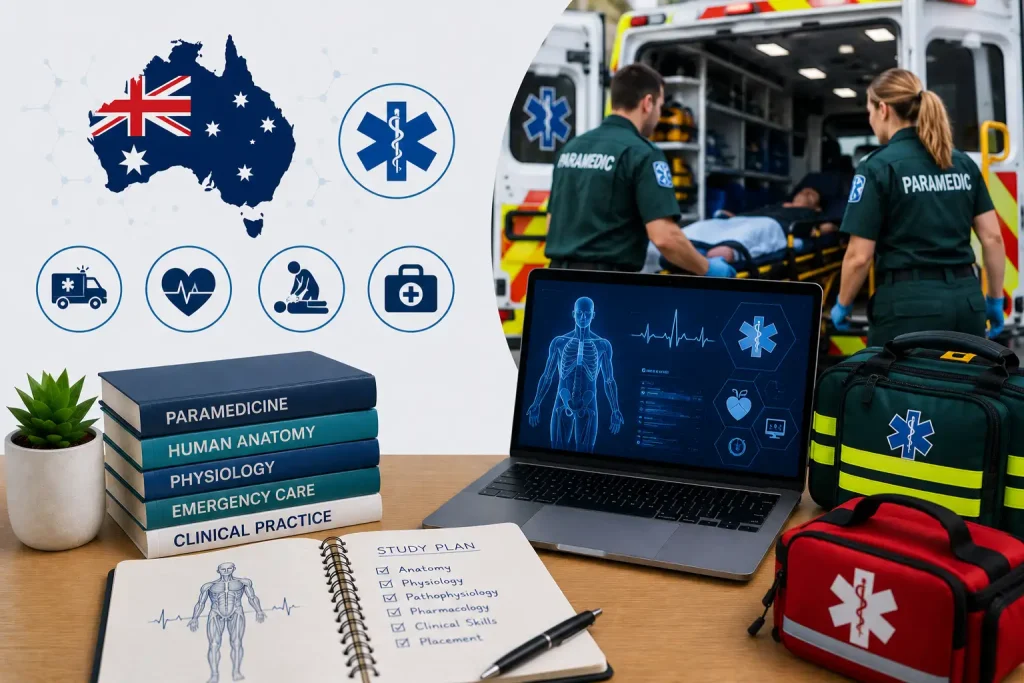
If you are tossing up between paramedicine and other health degrees, the key differentiator is that paramedicine gives you a guaranteed, accredited clinical career in exactly three years. You don’t need to do honours, you don’t need a master’s degree (unless you want to become an intensive care or flight paramedic later), and you don’t need to go through a separate internship process.
Paramedicine
- Duration: 3 years to full registration
- ATAR: 60–95 (smart choice is 60–80)
- Work environment: Ambulances, helicopters, remote sites
- Hours: Shift work (8 or 12-hour rotations, nights, weekends)
- Outcome: Guaranteed accredited health professional
Biomedical / Medical Science
- Duration: 3 years (+ further study to actually work in health)
- ATAR: 65–95
- Work environment: Labs, offices (if you don’t do postgrad)
- Hours: Generally standard business hours
- Outcome: Not a clinical qualification. Requires Honours/Masters/PhD to advance.
If you want a career with high adrenaline, immediate patient responsibility, and the ability to save lives straight out of university, paramedicine is unmatched. If you prefer research, lab work, or want to aim for graduate medicine later, then Biomedical Science might be the better foundational degree.
Frequently Asked Questions
The ATAR for paramedicine in Australia typically ranges from 60.00 to 95.00. The massive range exists because elite universities like Monash and the University of Sydney have inflated ATARs of 90–95 due to students using it as a pre-medicine pathway. In reality, the core academic requirement to be a paramedic is much lower. Regional and mid-tier universities like CSU, UniSA, and QUT offer accredited paramedicine degrees with ATARs between 60.00 and 85.00.
At universities like Monash (VIC) and USYD (NSW), the ATAR for paramedicine sits around 90-95. This is not because the job of a paramedic requires a 95 ATAR—it is heavily inflated by high-achieving students who use paramedicine as a ‘backdoor’ into graduate medicine, or by the general prestige effect of Group of Eight universities. You learn the exact same clinical skills at a 65-ATAR university as you do at a 95-ATAR university.
No. Ambulance services in Australia (like Ambulance Victoria or NSW Ambulance) do not ask for your ATAR when you apply for a job. They care about two things: 1) That your degree is accredited by the Paramedicine Board of Australia, and 2) That you have a valid driver’s license, physical fitness, and pass their recruitment process. A graduate from a 65-ATAR course is equally employable as a graduate from a 95-ATAR course.
Prerequisites vary by university, but most require English and at least one Science subject (Biology, Chemistry, or Physics). Some universities recommend or require Mathematics Methods, while others accept General Mathematics. Unlike medicine or radiography, there is no strict, universal physics or chemistry requirement for paramedicine, making it more accessible from a subject-selection standpoint.
Yes, it can be an excellent pathway into graduate medicine. Paramedics develop exceptional clinical decision-making skills, real-world patient experience, and emotional resilience—qualities that graduate medical schools heavily value in interviews. However, you still need to achieve a very high GPA (6.0+/7.0) in your degree and score well on the GAMSAT to be competitive for medicine entry.
Disclaimer: The information in this article is based on the most recent available data and historical ATAR trends for Paramedicine programs in Australia for 2026 entry. ATAR cutoffs fluctuate annually based on applicant demand. Always verify current prerequisites, ATAR cutoffs, and most importantly, PBA/CAA accreditation status directly with the universities and the Paramedicine Board of Australia before making application decisions.