What ATAR Do You Need for Radiography in Australia?
The complete guide to ATAR requirements for Diagnostic Radiography and Radiation Therapy — including university cutoffs, prerequisites, and why it’s a brilliant alternative to medicine.
The ATAR you need for radiography in Australia typically ranges from 75.00 to 95.00, depending on the university and whether you study Diagnostic Radiography or Radiation Therapy. The most competitive program is the Bachelor of Applied Science (Diagnostic Radiography) at the University of Sydney, which requires an ATAR of approximately 93.00–95.00. Mid-tier universities like RMIT and QUT generally require 80.00–85.00, while regional universities like UniSA and CSU offer accessible pathways with ATARs around 75.00–80.00. Crucially, you must ensure your chosen degree is accredited by the Medical Radiation Practice Board of Australia (MRPBA), otherwise you cannot work as a radiographer.
Diagnostic Radiography vs. Radiation Therapy
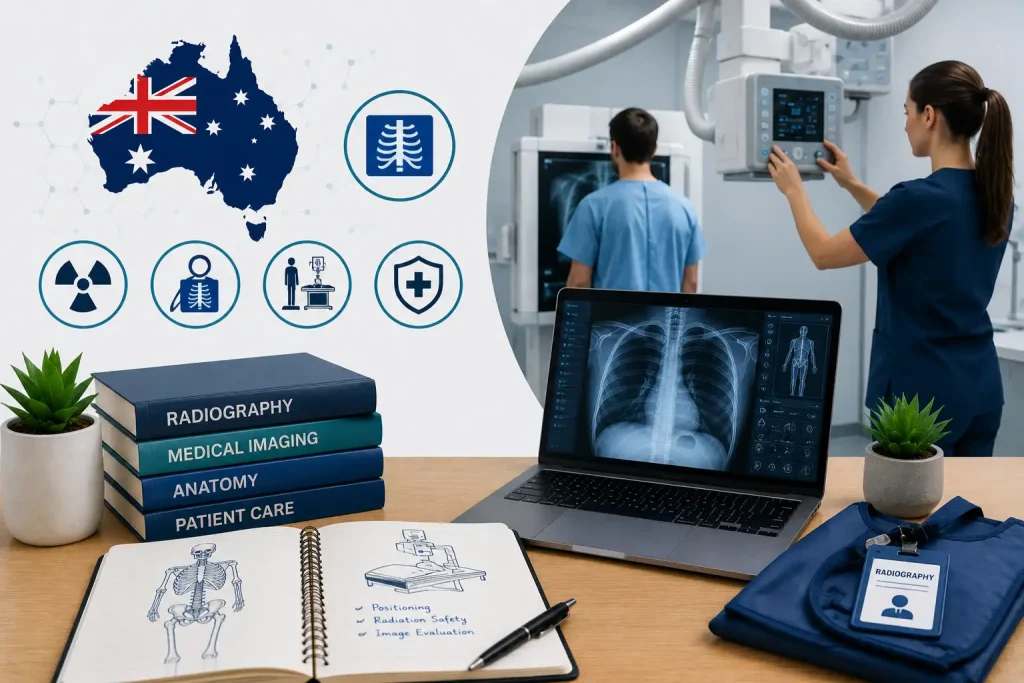
Before looking at ATAR requirements, you need to understand that “radiography” actually refers to two distinct professions in Australia. Both fall under Medical Radiation Science, but they do very different jobs. Some universities offer dedicated degrees for each, while others offer a general first year before you choose your specialisation.
Diagnostic Radiography
- Role: Uses X-rays, CT scans, MRIs, and ultrasound to diagnose diseases and injuries
- Work environment: Hospital imaging departments, private radiology clinics
- Demand: Extremely high. Every hospital and most large clinics need diagnostic radiographers
- Availability: Offered at more universities (USYD, RMIT, QUT, UniSA, CSU, Curtin)
- Best for: Students interested in anatomy, technology, and diagnostic problem-solving
Radiation Therapy
- Role: Plans and delivers targeted radiation treatment, primarily for cancer patients
- Work environment: Specialised oncology centers and major hospitals
- Demand: High, but fewer positions overall than diagnostic radiography
- Availability: Offered at fewer universities (USYD, QUT, RMIT, UniSA)
- Best for: Students who want long-term patient relationships and a direct role in cancer treatment
ATAR Requirements by University — NSW & ACT
New South Wales is home to the most competitive radiography program in the country. The University of Sydney’s ATAR requirements are notoriously high across the board, and their diagnostic radiography program is no exception—it sits right up there with some of their most prestigious degrees.
| University | Degree | Indicative ATAR | Notes |
|---|---|---|---|
| University of Sydney | BAppSc (Diagnostic Radiography) | ~93.00–95.00 | Highest ATAR for radiography in Australia. Very limited places. |
| University of Sydney | BAppSc (Radiation Therapy) | ~90.00–93.00 | Slightly lower than diagnostic, but still highly competitive. |
| U Newcastle | BMed Radiation Science (Honours) | ~85.00 | Generalist degree with specialisations available in later years. |
| CSU (Port Macquarie) | BMedical Radiation Science (Diagnostic) | ~75.00 | Excellent regional option. Strong clinical placement network. |
| CSU (Wagga Wagga) | BMedical Radiation Science (Radiation Therapy) | ~75.00 | One of the most accessible pathways to radiation therapy in Australia. |
ATAR Requirements by University — Victoria
Victoria offers strong, mid-tier entry points into radiography. RMIT is the primary provider in the state, offering both diagnostic and radiation therapy streams. The programs here are highly regarded by industry for their practical, hands-on approach.
| University | Degree | Indicative ATAR | Notes |
|---|---|---|---|
| RMIT | BBiomedical Science (Medical Imaging) | ~82.00–85.00 | Leads to accreditation as a diagnostic radiographer. Bundoora campus. |
| RMIT | BBiomedical Science (Radiation Therapy) | ~80.00–83.00 | Accredited radiation therapy pathway. Strong clinical placements. |
| Monash | BMedical Sciences / MMedical Imaging | ~88.00–90.00 | Postgraduate entry model. High ATAR for the bachelor’s, then progression to the masters. |
ATAR Requirements by University — Queensland
Queensland provides some of the best options for students aiming for radiography, particularly through QUT. If you are studying under the QCE system, understanding how your subjects scale is vital—check our guide on QCE ATAR requirements for top universities to ensure you’re maximizing your score for QUT’s competitive cutoffs.
| University | Degree | Indicative ATAR | Notes |
|---|---|---|---|
| QUT | BBiomedical Science (Medical Imaging) | ~84.00–86.00 | QLD’s premier diagnostic radiography program. Based at Gardens Point. |
| QUT | BBiomedical Science (Radiation Therapy) | ~82.00–84.00 | Highly regarded radiation therapy program. Smaller cohort sizes. |
| CQUni | BMedical Imaging | ~70.00–75.00 | Offered in partnership with CQUni, though check current clinical placement availability. |
| USC | BMedical Imaging | ~80.00 | Newer program. Smaller cohorts mean excellent access to equipment. |
ATAR Requirements by University — Western Australia
Western Australia has a single major provider for medical imaging, but it is a robust and well-respected program with excellent employment outcomes in the WA health system.
| University | Degree | Indicative ATAR | Notes |
|---|---|---|---|
| Curtin | BSc (Medical Imaging Science) | ~82.00–85.00 | WA’s only diagnostic radiography degree. Very strong graduate outcomes in WA. |
ATAR Requirements by University — South Australia & Tasmania
South Australia offers the most accessible entry points into radiography in the country, alongside some of the highest-regarded programs. UniSA is a national leader in medical radiation science.
| University | Degree | Indicative ATAR | Notes |
|---|---|---|---|
| UniSA | BMedical Radiation Science (Medical Imaging) | ~78.00–80.00 | Exceptional value. Lower ATAR but incredible industry reputation and facilities. |
| UniSA | BMedical Radiation Science (Radiation Therapy) | ~75.00–78.00 | One of the lowest ATAR pathways to radiation therapy in Australia. |
| CSU (via SA campus/online) | BMedical Radiation Science | ~75.00 | CSU accepts SA students, though placements are arranged locally where possible. |
Prerequisite Subjects for Radiography
Radiography programs have stricter prerequisites than many other health degrees. Because the work involves complex physics and anatomy, universities want to see evidence of your capability in these areas before you enroll.
| Subject | Status | Why It Matters |
|---|---|---|
| English | Mandatory (All) | Required for communication with patients and writing clinical reports. |
| Mathematical Methods | Mandatory (Most) | Essential for understanding the physics calculations used in imaging and dosing. |
| Physics | Mandatory or Assumed (Most) | Critical. Medical imaging is fundamentally applied physics (radiation, magnetism, sound waves). |
| Biology | Recommended (Some) | Helps with human anatomy and physiology, which you’ll study extensively. |
| Chemistry | Rarely Required | Not typically needed for radiography, unlike medicine or pharmacy. |
The Accreditation Trap: What You Must Check
This is the single most important thing to understand before applying for radiography in Australia. Unlike degrees like business or arts where the university’s reputation alone carries weight, in radiography, the degree itself must be legally accredited for you to work.
The Medical Radiation Practice Board of Australia (MRPBA) maintains a public register of approved programs of study. If a degree is not on this list, graduating from it means you cannot register as a radiographer in Australia.
The Australian Institute of Radiography (AIR) is the accrediting authority. Programs that have passed AIR accreditation are subsequently approved by the MRPBA. University websites will usually state “AIR Accredited” or “MRPBA Approved.”
Some universities offer Bachelor of Health Science or Bachelor of Biomedical Science degrees that contain radiography units but are NOT accredited as standalone radiography degrees. These degrees do not lead to registration. Always read the fine print.
Radiography vs. Medicine: Is It a Good Backup?
Many high-achieving students initially aim for medicine but find the 99+ ATAR requirement for medicine out of reach, or they decide against the grueling decade-long training process. Radiography has emerged as one of the most compelling “plan B” options for aspiring doctors.
Radiography Pathway
- Entry ATAR: 75–95 (much more accessible)
- Study duration: 4 years
- Starting salary: $85,000–$95,000
- Working hours: Generally predictable shifts (8-hour rosters)
- Patient interaction: High, but focused and procedural
- Debt: Much lower (4 years of HECS vs 6+ years)
Medicine Pathway
- Entry ATAR: 95–99.90+ (extremely competitive)
- Study duration: 6–8 years (including internships)
- Starting salary: $75,000–$85,000 (as an intern/junior resident)
- Working hours: Unpredictable, night shifts, weekends, overtime
- Patient interaction: Deep, long-term, high stress
- Debt: Significantly higher
If you are looking at a 90+ ATAR and want a career in health, radiography often provides a better work-life balance, faster entry to the workforce, and a surprisingly higher starting salary than a junior doctor. If you want to explore other health degrees with similar entry requirements, compare this with the ATARs needed for medical science, pharmacy, or occupational therapy.
Yes. Some radiography graduates use their undergraduate degree as a stepping stone to graduate-entry medicine (MD). While you’ll still need to sit the GAMSAT and interview, the deep anatomical knowledge, patient interaction experience, and science foundation from a radiography degree make for an incredibly strong graduate medicine application.
Frequently Asked Questions
The ATAR required for radiography (medical imaging) in Australia typically ranges from 75.00 to 95.00. Entry-level programs at universities like UniSA or CSU require an ATAR of around 75–80. Mid-tier universities like RMIT or QUT usually require 80–85. The most competitive program is the Bachelor of Applied Science (Diagnostic Radiography) at the University of Sydney, which requires an ATAR of approximately 93.00 to 95.00.
No. Diagnostic Radiography involves using medical imaging (X-rays, CT scans, MRIs) to diagnose injuries and diseases. Radiation Therapy involves using targeted radiation to treat diseases, primarily cancer. Both are classified as medical radiation science, but they are distinct degrees with different career paths, though some universities offer a general first year before specialisation.
Prerequisites vary by university, but the most common requirements are English, Mathematics Methods, and a science subject—usually Physics, but sometimes Biology or Chemistry is accepted. Physics is highly recommended as it provides the foundation for understanding imaging equipment and radiation physics.
Yes, radiography is an excellent alternative to medicine. It offers direct patient interaction, a high level of medical knowledge, and strong earning potential without the grueling 6+ year study timeline or 99+ ATAR requirement. Radiographers graduate in 4 years, can earn $85,000-$95,000+ in their first year out, and often have more predictable working hours than junior doctors.
You must ensure the degree is accredited by the Medical Radiation Practice Board of Australia (MRPBA), usually through the Australian Institute of Radiography (AIR). If a degree is not MRPBA-accredited, you will not be able to register as a radiographer in Australia. Always check the MRPBA register of accredited programs before applying.
Yes. Australia has a chronic shortage of diagnostic radiographers and radiation therapists, particularly in regional and rural areas. Graduate employment rates are consistently above 90%, and many students receive job offers before they even finish their final clinical placements. This makes radiography one of the most secure health degrees you can choose.