HSC Scaling Guide 2026: Which Subjects Scale the Best in NSW
The exact difference between NESA and UAC, the Maths Extension 2 trap, and the real strategies that move your ATAR — not the ones your friends are guessing at.
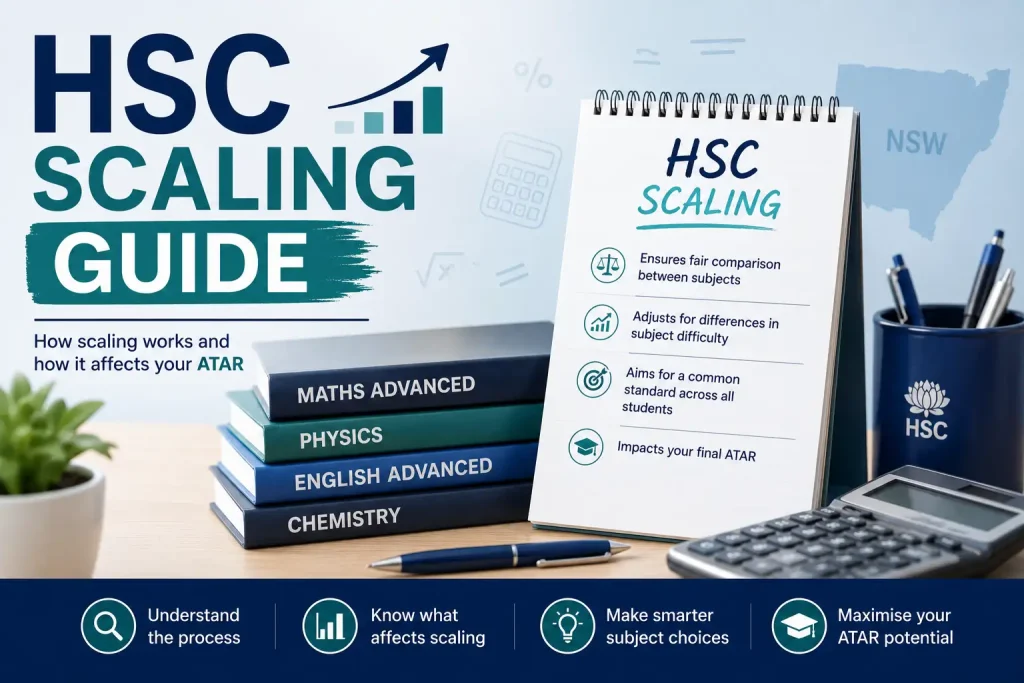
HSC scaling is a mathematical process run by UAC (not NESA) that adjusts your HSC marks so that all subjects are compared on a level playing field. If the students in your subject perform well across all their other subjects, your subject scales up. If they perform poorly, it scales down. UAC then adds together your best 10 units of scaled marks (including at least 2 units of English) to calculate your ATAR. Maths Extension 2 scales the highest; Standard English and VET scale the lowest.
NESA vs UAC: The Two-System Confusion
If you only read one section of this guide, make it this one. The single biggest reason students misunderstand HSC scaling is that they confuse two completely different organisations doing two completely different mathematical operations on their results.
NESA (NSW Education Standards Authority)
- Runs the HSC exams
- Marks your exams
- Combines your school assessment marks with your exam marks
- Applies “moderation” (adjusting school assessments based on exam performance)
- Applies “alignment” (mapping your combined mark to a Band 6/5/4 etc.)
- Produces your HSC Mark (out of 100)
- Does NOT scale. Does NOT calculate ATAR.
UAC (Universities Admissions Centre)
- Has nothing to do with your exams
- Receives your HSC Marks from NESA
- Applies “scaling” (adjusting HSC Marks based on the academic strength of the statewide cohort in each subject)
- Adds together your best 10 units of Scaled Marks
- Ranks you against the state
- Produces your ATAR (0.00–99.95)
- Does NOT mark exams. Does NOT issue HSC results.
When you get your HSC results in December, you see your NESA HSC Mark (e.g., 87 in Physics). When you get your ATAR a few days later, UAC has secretly converted that 87 into a Scaled Mark (which might be 91 or 83 — you never see this number). If you don’t understand that these are two different numbers calculated by two different organisations, you will never understand why your ATAR is higher or lower than you expected.
How HSC Scaling Actually Works (Step-by-Step)
Here is exactly what happens to your marks between handing in your last exam and receiving your ATAR.
Your teachers give you assessment marks. NESA looks at how your school’s grade performed on the exam. If your school’s exam marks are lower than the school assessments, NESA drags the assessment marks down to match. If higher, they push them up. Your rank within your school cohort is preserved.
NESA takes your moderated assessment mark and your raw exam mark, averages them, and maps the result to a performance band. This produces your final HSC Mark out of 100. This is the number you see on your HSC results page.
UAC takes your HSC Mark and applies scaling. UAC looks at how all the students in your subject performed across ALL their other subjects. If they were strong overall, your mark is scaled up. If weak, scaled down. This produces your hidden Scaled Mark (which you are never shown).
UAC adds together your Scaled Marks for your best 10 units. You must include at least 2 units of English. Any units beyond 10 are ignored — there is no 10% bonus for extra subjects in NSW (unlike Victoria).
Your total aggregate is ranked against every other eligible HSC student. Your percentile position is your ATAR. 99.95 means you are in the top 0.05% of the state.
Unlike Victoria, where a 5th or 6th subject counts for 10%, in NSW only your best 10 units count at full value. Units 11 and 12 contribute absolutely nothing to your ATAR. This makes doing more than 10 units purely an insurance strategy — if you bomb one subject, another can replace it.
Visual HSC Scaling Guide (2024 Data)
The bars below show the approximate Scaled Mark you would receive for an HSC Mark of 80 in each subject. An HSC Mark of 80 is a low Band 5 — a common result for solid students. Notice how the same “80” translates to vastly different ATAR value depending on the subject.
Highest Scaling HSC Subjects
Neutral / Moderate Scaling Subjects
Lowest Scaling HSC Subjects
The Maths Extension 2 Trap
Every year, hundreds of students fall into this trap. It goes like this:
A student in Year 11 hears that “Extension 2 scales the best.” They scrape through Extension 1, enrol in Extension 2 in Year 12, and spend the entire year struggling. In the exam, they score a raw mark of 55/100. After scaling, that 55 becomes maybe 70/100.
Meanwhile, if they had dropped back to just Extension 1 and Advanced Maths, and used those extra study hours on their other subjects, they might have scored 85 in Advanced (scaled ~90), 80 in Extension 1 (scaled ~89), and pulled up their English from 75 to 82.
The student who chased scaling lost 15+ ATAR points.
Scaling can lift a 75 to an 85, or an 85 to a 93. But it cannot turn a 45 into an 80. The maths simply doesn’t work that way. If you are not comfortably in the top 30-40% of your Extension 2 class by Term 2 of Year 12, the scaling benefit will not save you. The opportunity cost — the time you spend on E2 that you could spend on your other subjects — will destroy your ATAR.
Who should do Extension 2? Students who genuinely love mathematics, who scored top marks in Extension 1 in Year 11, and who find the E2 content engaging rather than punishing. For these students, E2 is a free 10-12 points of scaling. For everyone else, it is an ATAR trap.
Scaling Strategy by ATAR Goal (90+ vs 80+ vs 70+)
The “right” scaling strategy depends entirely on what ATAR you are actually aiming for. A student targeting 95+ has to play a completely different game than a student targeting 75+.
| Your ATAR Goal | Scaling Reality | The Smart Strategy |
|---|---|---|
| 95.00+ | You are competing against students who ALL have high-scaling subjects. You cannot afford any low-scaling subjects in your top 10 units, because your competitors don’t have them. | Maximise high-scaling subjects: Maths Ext 1/2, Physics, Chemistry, English Advanced or Extension. Every unit should scale up. An 80 in English Standard (scaled ~68) will actively drag you out of the 95+ range. |
| 85.00 – 94.99 | A mix of high and moderate scaling is fine. One lower-scaling subject won’t kill you, but two might. | Maths Advanced + one Science as your core. English Advanced is strongly preferred over Standard. You can afford one “interest” subject (e.g., Modern History, Business) as long as you score 85+ in it. |
| 75.00 – 84.99 | Raw performance matters more than scaling at this level. A 90 in a low-scaling subject beats a 65 in a high-scaling subject every time. | Choose subjects you are genuinely good at, even if they scale lower. A 90 in Business Studies (scaled ~80) is far more valuable than a 65 in Physics (scaled ~68). Don’t fake it — play to your strengths. |
| Below 75.00 | Scaling barely matters. Your priority is passing and getting the highest raw marks possible in whatever subjects you can manage. | Drop to Standard English and Standard Maths if Advanced is causing you to fail. A 70 in Standard English (scaled ~60) is infinitely better than a 45 in Advanced English (scaled ~45). Survival first, optimisation second. |
The “Alignment” Myth: Why 50/50 Isn’t 50/50
This is a subtle point that trips up a lot of students who try to predict their HSC marks before results come out.
Many students think: “My school assessment mark is 85, and I think I got 75 in the exam. So my HSC mark will be 80 (the average).”
That is wrong. NESA does not simply average your assessment and exam marks. They first moderate your school assessment mark based on your exam performance and the exam performance of your cohort. Then they take the average of your moderated assessment and your exam mark, and align that average to a band.
Alignment means NESA looks at the raw statistical distribution of all marks in the state for that subject and maps them to fixed cut-offs. For example, in many subjects, a raw combined mark of 83 might be aligned down to an HSC Mark of 80, because the state-wide distribution has a cluster of students around that mark.
Your HSC Mark (out of 100) is not a straightforward percentage. It is a statistically mapped value. When UAC takes this HSC Mark and applies scaling to it, there are two layers of statistical adjustment happening. This is why predicting your ATAR from practice exams is essentially impossible — you are guessing through two layers of mathematics you cannot replicate.
Why ATAR Calculators Lie to You
Every Year 12 student in NSW uses an online ATAR calculator at some point. They are useful for broad planning — but they are also the single biggest source of false expectations in the HSC.
Here is why they are inaccurate:
- They use last year’s scaling data. Scaling changes every year based on that year’s cohort. The difference is usually small (1-2 points per subject) but it compounds across 5 subjects to a potential 5-10 ATAR point error.
- They assume uniform performance. You type in “80 for all subjects.” In reality, you will get 85 in one, 72 in another, 90 in a third. This non-uniform profile interacts with scaling differently than a flat profile, and calculators can’t model this.
- They don’t know your exact unit structure. If you do 12 units and drop your worst 2, the calculator can’t predict which 2 you’ll drop. Your actual ATAR depends on which subjects end up being excluded.
- They show HSC marks, not scaled marks. Most calculators ask for your “expected HSC mark” and apply a generic scaling table. UAC’s actual algorithm is more nuanced than a simple lookup table.
Enter your marks, then subtract 3 to 5 points from the result. If the calculator says 88, plan for 83-85. If you end up with 88, it’s a pleasant surprise. If you plan for 88 and get 83, you miss out on a course preference. Always build a buffer. The calculator gives you an upper bound, not a realistic expectation.
The English Reality Check
English is compulsory, and 2 units of English must be in your best 10. This makes your English scaling decision one of the most consequential choices in your HSC.
| English Subject | HSC Mark 80 → Scaled | HSC Mark 90 → Scaled | The Honest Take |
|---|---|---|---|
| English Extension 1 | ~85 | ~94 | Scales well. Worth it if you are genuinely strong at English. Adds a unit to your total. |
| English Extension 2 | ~88 | ~96 | Highest scaling English. But requires a major work. Only for committed English students. |
| English Advanced | ~78 | ~89 | The standard choice for ATAR 80+ students. Scales slightly down, but not catastrophically. |
| English Standard | ~68 | ~79 | Scales down significantly. An 80 in Standard is worth less than a 70 in Advanced. If you can handle Advanced, stay in Advanced. |
| EAL/D | ~72 | ~83 | Sits between Standard and Advanced. Scales down, but less than Standard. Only available to eligible students. |
| English Studies | ~55 | ~65 | Does NOT count towards an ATAR. Non-ATAR English. Only choose this if you are absolutely not eligible for Standard or Advanced. |
If you score 75 in English Advanced, your scaled mark is roughly 74. If you drop to Standard and score 82 (because it’s easier), your scaled mark is roughly 71. You actually went backwards. The only time dropping to Standard makes sense is if dropping Advanced would free up enough study time to raise your other subjects by more than the 3-5 point penalty you absorb from Standard’s lower scaling.
Frequently Asked Questions
Disclaimer: Scaling data in this article is approximate and based on aggregate trends from published UAC data and independent HSC scaling analyses. Actual scaling varies every year depending on cohort composition. Scaled marks are never publicly released by UAC — all figures in this guide are informed estimates used for educational purposes. Always treat calculator results and scaling estimates as approximate guides, not guarantees. Consult your school’s careers advisor for personalised subject selection advice.