Subject Scaling Explained: How ATAR Scaling Works in Australia
It is the most misunderstood part of Year 12. This guide cuts through the rumours and explains exactly how your subjects determine your final ATAR.
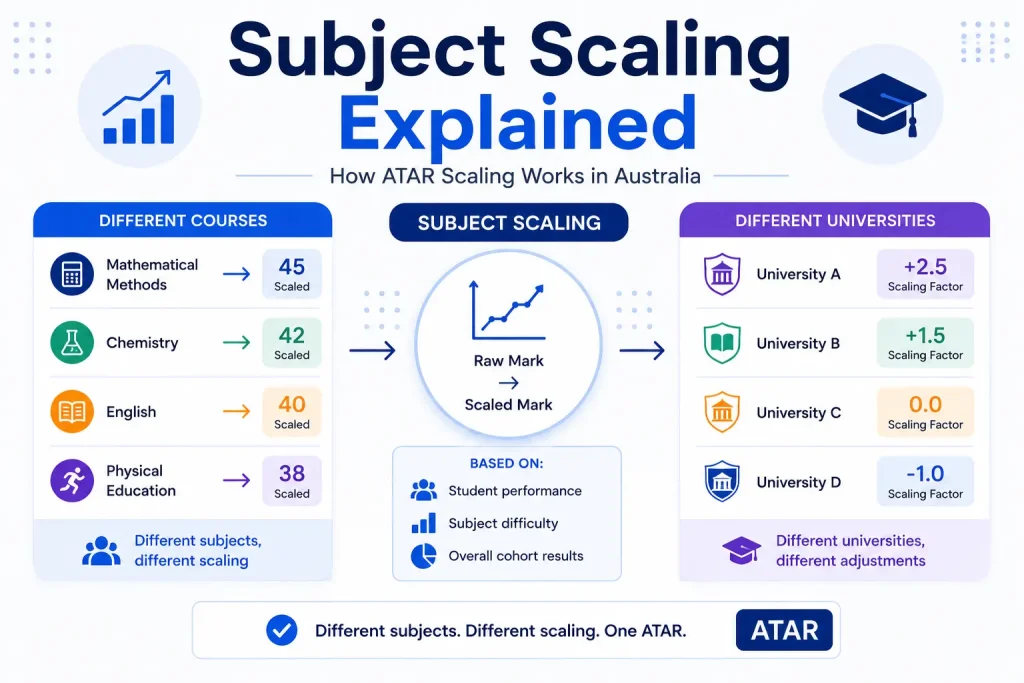
ATAR scaling is a statistical process that adjusts your raw subject scores based on the academic strength of the students in your class, not the difficulty of the subject. If the students in your subject perform well across all their other subjects, your subject scales up. If they perform poorly, it scales down. This ensures that a high mark in a subject with strong students is not penalised compared to a high mark in a subject with weaker students.
What Is ATAR Scaling? (The Simple Version)
Imagine two students. Student A scores 80% in Specialist Mathematics. Student B scores 80% in General Mathematics. Both got the same percentage of questions right. But Student A’s score will contribute significantly more to their final ATAR than Student B’s. Why?
Because scaling is not about the subject — it is about the cohort.
The students taking Specialist Mathematics are, on average, the strongest academic performers in the state. They tend to score highly in all their other subjects too. To ensure Student A’s 80% in Specialist Maths is valued fairly against the rest of the state, the system scales that score up.
The students taking General Mathematics include a much wider range of academic abilities. Their average performance across all subjects is lower. So Student B’s 80% in General Maths gets scaled down — not because the subject is “easy,” but because an 80% in that cohort represents a different level of academic achievement than an 80% in the Specialist Maths cohort.
Scaling adjusts your marks so that your ATAR reflects your overall academic achievement relative to all other students, regardless of which subjects you chose.
Why Does Scaling Exist?
Without scaling, the ATAR system would be fundamentally unfair. Here is the problem it solves:
A student who takes Physics, Chemistry, Specialist Mathematics, and English Extension is competing against the most academically driven students in the state. Even if they are brilliant, their raw marks might look modest because the assessments are tough and the cohort is fierce.
Another student who takes Visual Arts, Food Technology, General Maths, and English Standard might achieve higher raw percentages simply because the assessments and cohort are less competitive.
If we just averaged raw percentages, the second student would get a higher ATAR — despite the first student being demonstrably stronger across the board. Scaling prevents this injustice. It translates all subjects onto a common scale so that comparisons are meaningful.
If you are the top student in Physics, scaling will not change that — you will still have the highest scaled Physics score. Scaling shifts the entire distribution of scores up or down as a group. It adjusts the *value* of the score, not your *position* in the class.
The 4 Biggest Myths About Scaling
More confusion surrounds scaling than almost any other part of the ATAR system. Let’s dismantle the four most damaging myths.
❌ MYTH: “Hard” subjects scale up because they’re hard
A subject does not scale up because its content is difficult. If a very difficult subject was taken exclusively by students who struggled academically, it would scale *down*. Scaling tracks student performance, not syllabus difficulty.
✅ FACT: “Strong cohort” subjects scale up
Specialist Maths scales up because the students taking it are the state’s highest achievers. If those same students all chose to study a “soft” subject instead, that subject would suddenly scale up dramatically.
❌ MYTH: You should always choose the highest-scaling subjects
If you struggle with maths and score 30% in Specialist Maths, scaling might lift that to 35%. But if you could have scored 75% in Maths Methods (which scales less), your scaled score would be ~78%. You lost 43 points chasing scaling.
✅ FACT: Your raw score matters more than scaling
Scaling is a modifier, not a rescue. It typically adjusts scores by 2–10 points. A high raw score in a moderately scaling subject will almost always beat a low raw score in a highly scaling subject.
❌ MYTH: Scaling is a conspiracy to disadvantage certain schools
Scaling is applied uniformly across the entire state. A student scoring 40 in a subject at a selective school receives the exact same scaled score as a student scoring 40 in the same subject at a regional public school. The school you attend does not affect how your individual marks are scaled.
✅ FACT: Scaling is a blind mathematical process
The algorithms that calculate scaling have no knowledge of your school, your background, or your teacher. They only see numbers: your raw marks and the overall distribution of marks in your subject across the state.
How Scaling Actually Works (Step-by-Step)
While each state uses a slightly different mathematical model, the underlying process follows the same four stages. Here is what happens to your marks between finishing your final exam and receiving your ATAR.
Your actual marks for assessments and exams, reported by your school or marking authority. These are specific to each subject and not directly comparable across subjects.
Your raw marks are statistically adjusted based on the overall performance of the cohort taking that subject. In Victoria, this produces a “scaled study score” out of 50. In NSW, it produces a scaled HSC mark. This is the stage where the “scaling up” or “scaling down” happens.
Your best scaled marks are added together. The number of units counted varies by state: NSW and ACT count your best 10 units (typically 5 subjects), Victoria counts your best 4 English-relevant subjects plus your next 2 best, and other states generally count your best 4 to 6 subjects.
Your aggregate is ranked against every other eligible student in your state. Your position in that ranking — expressed as a percentile from 0.00 to 99.95 — is your ATAR. An ATAR of 90.00 means your aggregate was higher than 90% of the state.
In Victoria, an English subject must be one of your primary four counted subjects. In NSW, at least 2 units of English must be included in your best 10 units. This means your English scaled score always counts, making English scaling personally important for every student — even those aiming for STEM degrees.
Visual Scaling Guide: High vs Low Scaling Subjects
The bars below represent the approximate scaling impact of common Year 12 subjects. These are representative aggregates based on published data from VTAC and UAC — exact figures fluctuate slightly each year, but the relative order barely changes.
Highest Scaling Subjects
Lowest Scaling Subjects
The single biggest scaling decision most students make is their maths level. The gap between Mathematical Methods and General Mathematics is enormous — often 5–10 points of scaling difference. If you are capable of Methods, the scaling benefit alone is worth the extra effort. But if you would fail Methods, General Maths with a high raw score is still the better choice.
How Scaling Differs Across Australian States
While the principle of cohort-based adjustment is universal, the mathematics and terminology differ significantly. If you are moving states or comparing with friends interstate, these differences matter.
| State / Territory | Admissions Centre | What Gets Scaled | How Many Subjects Count? | Key Quirk |
|---|---|---|---|---|
| NSW / ACT | UAC | HSC marks are scaled based on the mean and spread of the candidature | Best 10 units (incl. 2 units English) | Extension 2 Maths is scaled separately and can contribute up to 2 units on its own |
| Victoria | VTAC | Study scores (out of 50) are scaled up or down to produce scaled scores | English (primary 4) + next best 2 subjects (total 6) | A 30 in Spec Maths can scale to 40+; VTAC publishes detailed scaling reports annually |
| Queensland | QTAC | Subject results (1–5, then converted to scaled scores) are adjusted by inter-subject scaling | Best 5 General subjects (or 4 Gen + 1 Applied) | Applied subjects (VET) can count but are heavily scaled down; only 1 can be included in the best 5 |
| Western Australia | TISC | School marks and WACE exam marks are combined and then scaled | Best 4 ATAR subjects | Scaling is relatively modest compared to VIC/NSW; school-based assessments are moderated by exam performance |
| South Australia / NT | SATAC | SACE Stage 2 results are scaled using a statistical model similar to VTAC | Best 4 Stage 2 subjects + Research Project | The Research Project counts but cannot be scaled — it is used at its raw score |
| Tasmania | UTAS | TCE results are scaled to produce a Tertiary Entrance Score | Best 5 Level 3 or 4 subjects | Smaller cohort means scaling is less dramatic but follows the same cohort-strength principle |
A “40” in Victoria means something entirely different from a “40” in NSW or a “40” in Queensland. Each state’s scoring system operates on a different scale. The ATAR itself is the only comparable metric — and even then, interstate ATARs are technically approximations converted by admissions centres.
The Golden Rule of Subject Selection
If you remember nothing else from this article, remember this rule. It overrides every other consideration:
“Confidently” means you can achieve a raw score well above the state average. If you are genuinely capable of Specialist Mathematics, take it — the scaling is a bonus on top of an already strong score. If you would struggle to pass Methods, drop to General Maths — a high raw score there beats a failed Methods score every time, regardless of scaling.
The most common ATAR disaster is a student who chooses a subject purely for scaling, finds it overwhelmingly difficult, scores in the bottom quartile, and watches their ATAR collapse. Scaling amplifies your raw performance — it does not replace it.
The 10-Point Reality Check
Scaling typically adjusts a score by 2 to 10 points in either direction. That means:
- A raw score of 45 in a high-scaling subject might become 52. Excellent.
- A raw score of 45 in a low-scaling subject might become 40. Disappointing, but still decent.
- A raw score of 20 in a high-scaling subject might become 25. Still terrible. Scaling could not save it.
The difference between a raw 45 and a raw 20 is 25 points — far larger than any scaling adjustment. Your subject choice should prioritise maximising your raw score first, and optimising for scaling second.
Strategic Subject Selection by Career Goal
Different career paths demand different subject strategies. Here is how to balance raw performance and scaling for the most common goals.
| Career Goal | Must-Have Subjects | Scaling Strategy |
|---|---|---|
| Engineering | Mathematical Methods, Specialist Maths (prereq at many Go8), Physics | You have no choice — these are prerequisites. The good news is they are the highest-scaling subjects available, so scaling works heavily in your favour. |
| Medicine / Health Science | Mathematical Methods, Chemistry, Biology (Physics at some Go8) | Chemistry and Methods scale well. Biology scales neutrally but is essential for prerequisites. Don’t swap Biology for a higher-scaling subject if it’s required. |
| Law / Commerce | English Advanced/Extension, Maths Methods (for Commerce) | English Advanced scales slightly positive. If doing Commerce, Methods adds valuable scaling. For pure Law, your best scaling strategy is maximising English and choosing your remaining subjects based on where you score highest. |
| Nursing | English (any level), Biology (assumed) | No maths prerequisite. Focus on English Advanced over Standard for the +2 point scaling bonus. Biology scales neutrally but prepares you well. Choose remaining subjects purely on raw performance. |
| Arts / Humanities / Teaching | English (any level), Humanities subjects of interest | Scaling works against you in this path (humanities subjects generally scale lower). Your strategy is simply to score as highly as possible in the subjects you enjoy — don’t pick subjects you hate just for scaling, because your raw score will suffer. |
| Uncertain / Undecided | English Advanced, Mathematical Methods, at least one Science | Keep doors open. Methods and a Science keep engineering, science, and commerce pathways available. If you later drop to a humanities-focused path, the scaling bonus from these subjects still helps your ATAR. |
What Happens If You Drop a Subject?
Many students consider dropping a subject in Year 12 — either because they are struggling, or because they believe having fewer subjects means each one counts more. Here is how dropping a subject affects your ATAR through the lens of scaling.
Dropping to Minimum Required
- In NSW, the minimum is 10 units (typically 5 subjects). If you drop to exactly 10, all your subjects count — including your weakest.
- In Victoria, you can count as few as 5 subjects (English + 4 others). If you do exactly 5, they all count.
- This is risky because a poorly performing subject drags down your aggregate with no safety net.
Keeping Extra Subjects
- If you do 6 subjects in NSW (12 units), only your best 10 units count. Your weakest 2 units are dropped.
- If you do 7 subjects in Victoria, your best 6 count (English + 5 others). Your weakest is dropped.
- This acts as an insurance policy. Even if one subject scales poorly or you have a bad exam, it can be excluded from your ATAR calculation.
Unless dropping a subject is necessary for your mental health or you are failing so badly that the subject is consuming all your study time, keeping an extra subject is almost always the smarter ATAR strategy. The worst-case scenario is that it doesn’t count. The best-case scenario is that it saves you if you underperform in another subject.
Scaling vs Adjustment Factors
Students often confuse scaling with adjustment factors (bonus points). They are entirely different mechanisms that operate at different stages of the admissions process.
| Feature | Scaling | Adjustment Factors |
|---|---|---|
| What is it? | Statistical adjustment of your subject marks based on cohort strength | Bonus points added to your ATAR for specific circumstances |
| Who applies it? | Your state’s curriculum/assessment authority (e.g., NESA, VCAA) as part of calculating your ATAR | Individual universities as part of their offer-making process |
| When does it happen? | Before you receive your ATAR | After you receive your ATAR, during the offer rounds |
| Can you control it? | Indirectly — by choosing which subjects to take | Yes — by applying for eligible schemes (regional, equity, subject bonuses) |
| Does everyone get it? | Yes — every subject is scaled for every student | No — only students who qualify for specific schemes receive them |
| Typical impact | −5 to +10 points per subject (before aggregation) | −0 to +10 points total (added to final ATAR to produce Selection Rank) |
In summary: Scaling changes the marks that produce your ATAR. Adjustment factors change the ATAR that universities use to make offers. Both can shift your final Selection Rank significantly — and the savviest students optimise for both.
Frequently Asked Questions
Key Takeaways
- Scaling is about cohort strength, not subject difficulty. A subject scales up because strong students take it — not because the content is hard.
- Your raw score always matters more than scaling. Scaling typically shifts scores by 2–10 points. A high raw score in a moderate-scaling subject beats a low raw score in a high-scaling subject every time.
- Mathematics is the biggest scaling lever. The gap between Specialist/Extension Maths and General Maths is the single largest scaling differential in the ATAR system.
- English counts everywhere. Most states mandate that an English subject is included in your primary calculation, making your English level a permanent scaling factor in your ATAR.
- Don’t chase scaling at the expense of raw performance. The “Golden Rule” is to choose the highest-level subject you can confidently score well in — not the highest-scaling subject you can survive.
- Keep an extra subject as insurance. Having one more subject than the minimum allows your weakest subject to be dropped from your ATAR calculation, protecting you from bad days and unexpected scaling outcomes.
- Scaling and adjustment factors are different things. Scaling changes the marks that produce your ATAR; adjustment factors change the ATAR that universities use to make offers. Optimise for both.
- Read your state’s published scaling report. VTAC, UAC, and QTAC all publish annual scaling data. Use it — it is the only reliable source of truth for how subjects scaled in the most recent year.
Disclaimer: Scaling data in this article is approximate and based on aggregate trends from published VTAC and UAC reports. Actual scaling varies every year based on cohort composition and performance. Scaling algorithms differ between states. This article provides general educational guidance and should not be treated as definitive advice for subject selection. Always consult your state’s published scaling reports, your school’s careers advisor, and your teachers when making subject decisions.