What ATAR Do I Need for Optometry?
The complete guide to the ATAR for Optometry in Australia — including why it rivals medicine, the hidden 5-year degree structure, and the exact prerequisites you need.
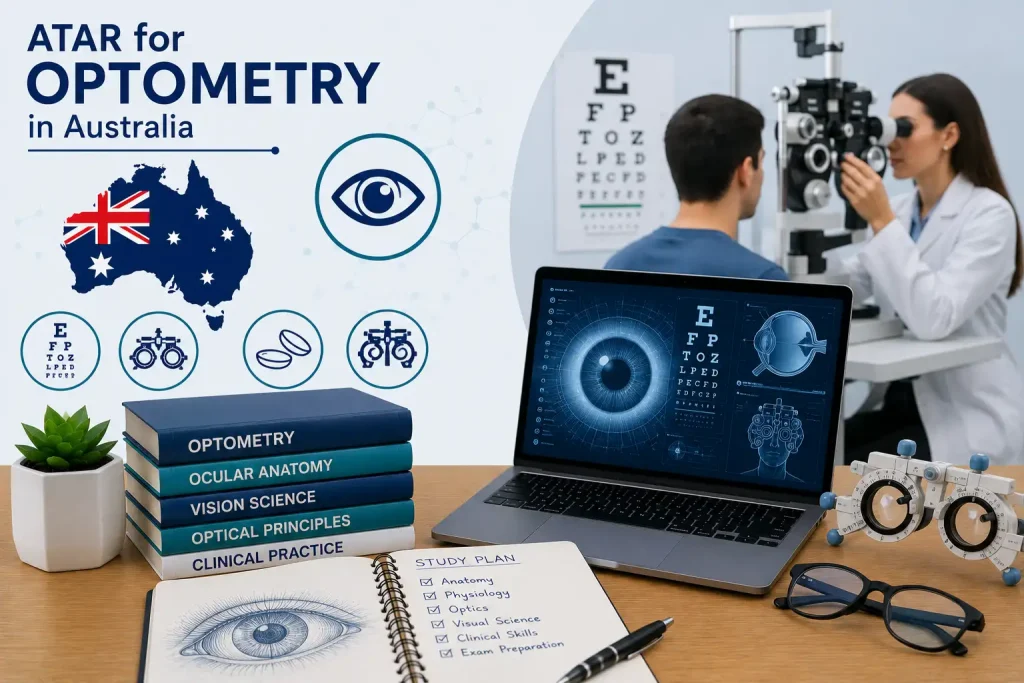
The ATAR for Optometry in Australia ranges from 85.00 to 98.00. However, you must understand a critical structural change: optometry is no longer a single bachelor’s degree. It is now a 5-year pathway consisting of a 3-year Bachelor of Vision Science followed by a 2-year Master of Optometry. The ATARs you see (85–98) are for the undergraduate bachelor’s degree. The most competitive programs are at UNSW and the University of Melbourne, requiring ATARs of 96.00–98.00. Mid-tier options like Deakin and Flinders require 85.00–92.00. If you want to accurately calculate your chances of hitting these high thresholds, using a reliable tool like ATARCalculator.net is highly recommended.
The 5-Year Reality: Bachelor + Masters Structure
The most important thing to understand about the ATAR for Optometry is that the number you see on a university website is not the ATAR to become an optometrist. It is the ATAR to get into the Bachelor of Vision Science.
About a decade ago, optometry was a 4 or 5-year bachelor’s degree. The profession has since elevated its minimum qualification to a master’s level. Now, every accredited optometry program in Australia follows this structure:
This is where your ATAR matters. You study optics, anatomy, physiology, and visual science. You cannot register as an optometrist with this degree alone.
This is the clinical qualification. You learn to diagnose eye diseases, prescribe lenses, and manage patient care. If you meet the GPA threshold during your bachelor’s (usually 5.0–5.5/7.0), you receive guaranteed entry into the masters at your same university.
After completing the Masters, you apply to the Optometry Board of Australia (OBA) for registration. You are now a fully qualified optometrist.
A Bachelor of Vision Science on its own has very limited career prospects. It is essentially a foundational science degree. You will not be able to work in an optometry clinic, prescribe glasses, or diagnose eye conditions without that 2-year Masters qualification. Make sure you are committed to the full 5 years before accepting a place.
ATAR Requirements by University — NSW & ACT
New South Wales is home to the most fiercely competitive optometry program in the country. If you are looking at the University of Sydney’s ATAR requirements or UNSW’s, you already know that health degrees at these institutions demand near-perfect scores. Optometry is no exception.
| University | Degree (Step 1) | Indicative ATAR | Notes |
|---|---|---|---|
| UNSW | BVision Science / MOptom | ~96.00–98.00 | Highest ATAR for optometry in Australia. Guaranteed Masters pathway if GPA > 5.0/7.0. |
UNSW is the only provider in NSW. Because there is no alternative in the state, the ATAR is artificially pushed even higher by demand. Interstate students often compete for these limited places.
ATAR Requirements by University — Victoria
Victoria offers two distinct pathways into optometry, catering to both the ultra-competitive high achievers and students with excellent, but not perfect, ATARs.
| University | Degree (Step 1) | Indicative ATAR | Notes |
|---|---|---|---|
| Uni of Melbourne | BSc / MOptom | ~96.00 | Melbourne Model. You do a general BSc first, majoring in Vision Science, then progress to the Masters. |
| Deakin | BVision Science / MOptom | ~85.00–88.00 | The most accessible optometry pathway in Australia. Excellent facilities in Waurn Ponds. |
If you want to be an optometrist but are tracking an ATAR of 85-88, Deakin is your best option in the country. You get the exact same registration outcome as a Melbourne or UNSW graduate, but with a 10-point lower ATAR threshold. The clinical training at Deakin is highly regarded, and their student cohorts report excellent satisfaction rates.
ATAR Requirements by University — Queensland
Queensland offers a single, highly respected optometry pathway through QUT. It sits in the mid-to-high ATAR range.
| University | Degree (Step 1) | Indicative ATAR | Notes |
|---|---|---|---|
| QUT | BVision Science / MOptom | ~93.00–95.00 | QLD’s only provider. Very strong program with deep clinical placement networks. |
ATAR Requirements by University — WA & SA
Flinders University in South Australia provides another excellent, slightly more accessible entry point into the profession.
| University | Degree (Step 1) | Indicative ATAR | Notes |
|---|---|---|---|
| Flinders | BVision Science (Honours) / MOptom | ~90.00–92.00 | Strong alternative to the eastern states. Includes an embedded honours year. |
Some universities may offer individual units in vision science or optics as part of a broader science or health degree, but unless they offer the full accredited Bachelor of Vision Science + Master of Optometry pipeline, they will not lead to registration. Currently, UNSW, Melbourne, Deakin, QUT, and Flinders are the only accredited providers in Australia.
Prerequisite Subjects for 2026 Entry
Optometry is a heavily physics and maths-dependent profession. The prerequisites are stricter than many other health degrees (like nursing or paramedicine) because you are studying the precise physical properties of light and lenses.
| Subject | Status | Why It Matters |
|---|---|---|
| English | Mandatory (All) | Standard requirement. Essential for patient communication. |
| Mathematical Methods | Mandatory (All) | Non-negotiable. You will use calculus and advanced algebra in optical physics. |
| Physics | Mandatory / Assumed (All) | Critical. Optics, lens design, and light behavior are pure physics. |
| Chemistry | Highly Recommended | Required for understanding ocular pharmacology, ocular anatomy, and biochemistry. |
| Biology | Recommended | Helpful for human anatomy and physiology, but physics is far more important. |
Many students drop Physics in Year 12 because it’s “hard,” thinking Biology is enough for a health career. For optometry, this is a fatal error. If you don’t do Physics in Year 12, you will almost certainly have to complete a bridging course before starting your degree, and you will be at a significant disadvantage in your first-year optical physics units.
Optometry vs. Pharmacy
Students interested in healthcare often debate between optometry and pharmacy. Both involve diagnosing conditions and prescribing treatments (glasses/medications), but the training and career structures are very different. You can view the specific ATAR breakdowns for pharmacy on our ATAR for Pharmacy in Australia page, but here is the direct comparison:
Optometry
- Duration: 5 years (Bachelors + Masters)
- ATAR: 85–98 (Very High)
- Scope of practice: Diagnosing eye diseases, prescribing lenses, managing ocular health
- Work environment: Private practice (corporate or independent), some hospital roles
- Lifestyle: Excellent. Predominantly Monday–Friday, 9–5 business hours
- Earning potential: Very high ($100k–$150k+). Often business owners later in career.
Pharmacy
- Duration: 4 years (Bachelor degree)
- ATAR: 75–95 (High, but generally lower than Optom)
- Scope of practice: Dispensing medications, patient counseling, reviewing drug interactions
- Work environment: Community pharmacies, hospitals, industry
- Lifestyle: Can involve shift work, weekends, and long hours in community pharmacy
- Earning potential: Good ($85k–$110k), though heavily impacted by pharmacy discounting wars.
Optometry vs. Medicine: Which is Harder?
It surprises many students to learn that the ATAR for Optometry at UNSW (96–98) is actually higher than the undergraduate medicine cutoffs at several other universities. So, is optometry harder to get into than medicine?
The answer is nuanced. When looking at what ATAR you need for medicine, you have to factor in that medicine uses a composite score (ATAR + UCAT + Interview). Optometry, on the other hand, is overwhelmingly ATAR-driven. There is no UCAT equivalent for undergraduate optometry entry. This means your raw academic performance in Year 12 carries almost 100% of the weight.
Optometry Entry
- Almost entirely based on ATAR
- No national aptitude test (like UCAT)
- No interview for the Bachelor’s degree
- If you get the ATAR, you are essentially guaranteed a spot
Medicine Entry
- Composite score (ATAR + UCAT + Interview)
- High-stakes UCAT exam required
- High-stakes MMI interview required
- High ATAR does not guarantee a spot if UCAT/Interview is weak
In short: Optometry is harder for pure academics (higher ATAR cutoffs), but medicine is harder overall because of the multiple high-pressure hurdles.
What If You Don’t Get the ATAR?
If you are tracking towards an ATAR in the 80–84 range and have your heart set on eye care, you have a few options. First, you could consider a related health degree. For example, looking into the ATAR for Occupational Therapy or other allied health professions might reveal an accredited clinical career you hadn’t considered.
However, if you specifically want to become an optometrist, your best strategy is:
- Transfer pathways: Enroll in a strong science degree (like a Bachelor of Science or Bachelor of Biomedical Science) at your chosen university. Achieve a very high GPA in first year, and then apply for an internal transfer into the Bachelor of Vision Science.
- Graduate entry: While less common, some universities may consider applicants with a relevant bachelor’s degree (with excellent grades) for advanced standing or direct entry into the Master of Optometry, though you usually still need to complete the foundational vision science units.
- Optical Dispensing: You can complete a Diploma of Optical Dispensing (much lower entry requirements) to work alongside optometrists, though you cannot diagnose or prescribe.