VCE Scaling Guide: How VTAC Scaling Actually Works
The exact mechanics, the highest and lowest scaling subjects, the 10% rule, and how to turn your VCE study scores into the maximum ATAR.
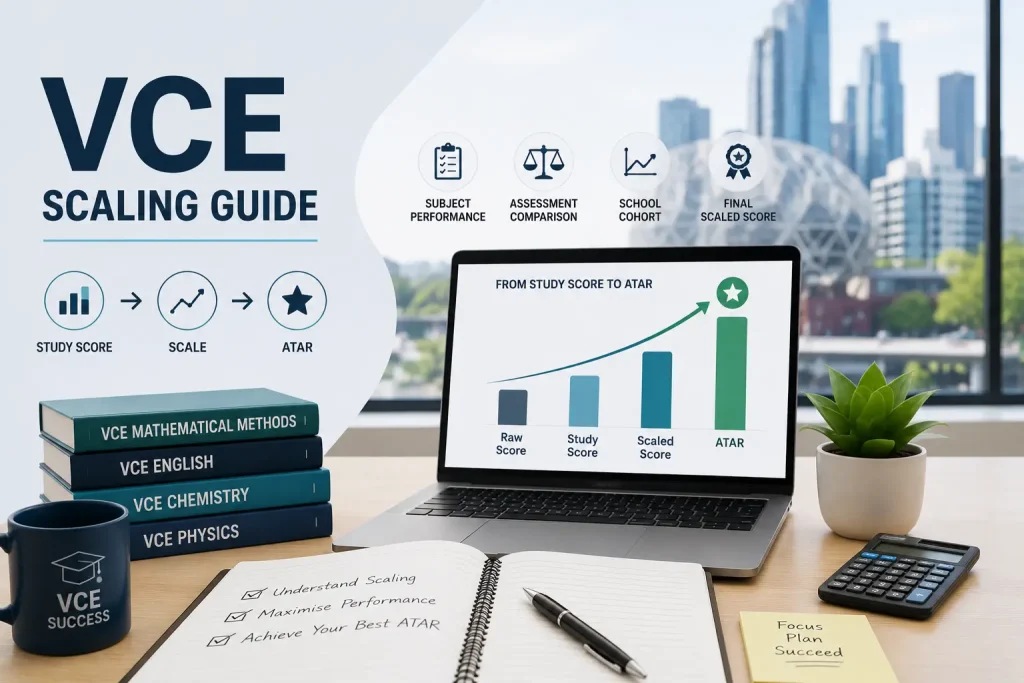
VCE scaling is VTAC’s process of adjusting your raw study scores (out of 50) based on the overall academic strength of the students in each subject. If the students in your subject perform well across all their other subjects, your subject scales up. If they perform poorly, it scales down. VTAC then takes your top 4 scaled scores (which must include an English subject) plus 10% of your 5th and 6th subjects to calculate your ATAR aggregate. Specialist Mathematics scales the highest; VET and Foundation Maths scale the lowest.
What Is VCE Scaling? (The Simple Version)
When you finish your VCE exams, VCAA gives you a raw study score out of 50 for each subject. A score of 30 means you performed roughly in the middle of the state for that subject.
The problem? A 30 in Specialist Mathematics does not represent the same level of academic achievement as a 30 in Health and Human Development. The students taking Specialist Maths are, on average, the strongest in the state. The students taking Health are a much broader mix.
VTAC scaling fixes this. It statistically adjusts your raw score up or down based on the overall academic performance of everyone else who took that subject. If you are in a subject with strong students, your score goes up. If you are in a subject with weaker students, your score goes down. The result is a scaled study score that can be fairly compared across all VCE subjects.
Your raw score is a foreign currency. Scaling converts it into Australian dollars so it can be compared. A “30 Yen” might only be worth “25 AUD”, while a “30 GBP” might be worth “40 AUD”. The number is the same — the value is completely different.
Why Does VTAC Scale VCE Subjects?
Without scaling, the VCE system would be profoundly unfair to students who choose challenging subjects alongside strong peers.
Consider two students. Student A takes Specialist Maths, Maths Methods, Physics, Chemistry, and English Language. Student B takes Health & Human Development, Business Management, Physical Education, English, and General Maths.
Student A is competing against the most academically driven cohort in Victoria. Even a brilliant performance might yield raw scores in the low 30s because the assessments are tough and the competition is fierce. Student B might score raw 40s in their subjects because the assessments and cohort are less competitive.
If VTAC just averaged the raw scores, Student B would receive a higher ATAR — despite Student A being demonstrably stronger. Scaling prevents this. It ensures your ATAR reflects your genuine academic capability relative to the entire state, not just relative to the specific group of students who happened to choose your subjects.
How the VCE ATAR Aggregate Is Calculated
Understanding the aggregate calculation is essential because it explains why subject selection strategy matters so much in Victoria.
Every VCE subject you complete receives a scaled study score (which can be higher or lower than your raw score). VTAC does this using an algorithm that analyses the total VCE performance of all students in each subject.
VTAC takes your English subject (any of English, EAL, English Language, or Literature) plus your next three highest scaled scores. These four subjects form the core of your aggregate. An English subject must be in this primary four — it cannot be a 5th or 6th subject.
If you studied more than four subjects, VTAC adds 10% of the scaled scores of your fifth and sixth subjects. This is where the “10% rule” comes from — a 5th or 6th subject can only contribute a maximum of about 5 points to your final ATAR.
Your total aggregate (theoretically out of ~210, but practically much lower) is ranked against every other eligible VCE student in Victoria. Your percentile position becomes your ATAR, from 0.00 to 99.95.
The English Rule: Why English Scaling Matters Most
In Victoria, an English subject must be one of your primary four subjects in the ATAR calculation. It cannot be shuffled into the 5th or 6th position where it would only count for 10%. This means your English scaled score carries full weight, making English the single most important subject to optimise for scaling in the VCE.
English / EAL (Mainstream)
- Taken by the vast majority of VCE students
- Massive, diverse cohort
- Result: Scales down slightly (a raw 30 typically scales to ~27–28)
- This negative scaling hits your ATAR directly because English is a primary 4 subject
English Language / Literature
- Taken by a smaller, more academically selective cohort
- Students generally perform well across all subjects
- Result: Scales up slightly (a raw 30 typically scales to ~31–33)
- This positive scaling directly boosts your ATAR because it is a primary 4 subject
A student with a raw 30 in mainstream English might get a scaled score of 28. A student with a raw 30 in English Language might get a scaled score of 32. That is a 4-point difference in the primary four — which translates to roughly 2–3 ATAR points. Over a VCE career, choosing English Language over mainstream English (if you are capable of both) can be worth more than the entire contribution of a 5th or 6th subject.
Visual VCE Scaling Guide (2024 Data)
The bars below show the approximate scaled score you would receive for a raw study score of 30 in each subject. A raw 30 is the state average — these bars show whether an “average” performance in that subject is worth more or less than 30 after scaling. Data is aggregated from the 2024 VTAC Scaling Report.
Highest Scaling Subjects
Neutral / Moderate Scaling Subjects
Lowest Scaling Subjects
Highest Scaling VCE Subjects (Detailed)
The table below shows how raw scores translate to scaled scores in the highest-scaling VCE subjects. Notice that the scaling benefit increases at higher raw scores — scaling rewards top performance more generously.
| Subject | Raw 25 → Scaled | Raw 30 → Scaled | Raw 35 → Scaled | Raw 40 → Scaled | Raw 45 → Scaled |
|---|---|---|---|---|---|
| Specialist Mathematics | ~31 | ~39 | ~44 | ~48 | ~50+ |
| Mathematical Methods | ~27 | ~35 | ~40 | ~44 | ~48 |
| Latin | ~29 | ~38 | ~43 | ~47 | ~50 |
| Physics | ~26 | ~34 | ~39 | ~43 | ~46 |
| Chemistry | ~26 | ~33 | ~38 | ~42 | ~45 |
| English Language | ~25 | ~32 | ~37 | ~42 | ~46 |
VTAC caps scaled study scores at 50. For high-scaling subjects like Specialist Maths, a raw score of 45 or above will almost always scale to 50 (the maximum). This means if you are capable of a raw 45+ in Spesh, the scaling benefit is technically “wasted” at the top end — you would have scored 50 in almost any subject at that level. The real value of high-scaling subjects is for students scoring in the 25–40 raw range.
Lowest Scaling VCE Subjects (Detailed)
Low-scaling subjects penalise your ATAR, but they are not “bad” subjects — they simply have cohorts whose overall academic performance is below the state average. The key question is whether the penalty matters enough to change your subject choices.
| Subject | Raw 25 → Scaled | Raw 30 → Scaled | Raw 35 → Scaled | Raw 40 → Scaled | Raw 45 → Scaled |
|---|---|---|---|---|---|
| English / EAL | ~22 | ~28 | ~34 | ~39 | ~44 |
| Business Management | ~20 | ~26 | ~32 | ~37 | ~42 |
| Health & Human Dev | ~19 | ~25 | ~31 | ~36 | ~41 |
| Physical Education | ~18 | ~24 | ~30 | ~35 | ~40 |
| General Mathematics | ~18 | ~23 | ~28 | ~33 | ~38 |
| Foundation Mathematics | ~14 | ~19 | ~24 | ~28 | ~33 |
Even in the lowest-scaling subjects, a raw score of 40+ scales to the high 30s. The penalty is most severe for average or below-average performances. If you are genuinely excellent at Business Management or HHD, a raw 40+ still contributes a solid scaled score to your ATAR. The students who are hurt most by low scaling are those scoring raw 25–32.
The 3 Biggest VCE Scaling Myths
❌ MYTH: “Hard” subjects scale better
If every top student in the state decided to take Health & Human Development next year, HHD would scale up dramatically — despite the content not changing at all. Scaling tracks who is in the room, not what is on the test. A subject’s difficulty is irrelevant; the cohort’s strength is everything.
✅ FACT: “Strong cohort” subjects scale better
Specialist Maths scales up because the students taking it are the state’s top academic performers. They score highly in all their other subjects too, which pulls the subject’s scaling mean upward. If those same students all chose Drama instead, Drama would become the highest-scaling subject in the VCE.
❌ MYTH: Low-scaling subjects will ruin my ATAR
If you score a raw 40 in Physical Education (which scales to ~35), that is still a perfectly respectable scaled score. The students who are “ruined” by low scaling are those scoring raw 25s in low-scaling subjects. A high raw score protects you from scaling penalties.
✅ FACT: Low raw scores are what hurt your ATAR
A raw 25 in General Maths scales to ~18. A raw 25 in Specialist Maths scales to ~31. The 13-point gap here is enormous. But notice: the student scoring 25 in Spesh is struggling badly. If they dropped to Methods and scored a raw 35, they’d get a scaled 40 — far better than the scaled 31 from struggling through Spesh.
❌ MYTH: VET subjects are worthless for ATAR
VET subjects scale poorly in the primary four, but they have a strategic use as a 5th or 6th subject. Because the 5th/6th subject only counts for 10%, the low scaling penalty is minimised. A VET subject as your 6th subject provides a safety net without dragging down your ATAR significantly.
✅ FACT: VET is a valid 5th/6th subject strategy
If you are doing five “serious” VCE subjects, adding a VET subject as a sixth option gives you insurance. If you have a bad exam day in one of your main subjects, the VET subject’s 10% contribution might be enough to cushion the blow. It costs you almost nothing in ATAR terms.
Strategic Subject Selection for VCE
The optimal VCE subject selection balances three factors: prerequisites (what you need for your target course), raw performance (where you can score highest), and scaling (the bonus or penalty applied to that raw score).
A raw 35 in Mathematical Methods (scaled ~40) beats a raw 25 in Specialist Mathematics (scaled ~31) every single time. The 10-point raw score advantage completely overwhelms the scaling differential. Never trade raw performance for scaling.
Subject Selection Templates by Goal
| Goal | Optimal English | Optimal Maths | Optimal Sciences / Humanities |
|---|---|---|---|
| Engineering / CS | English Language (scaling bonus) | Spec Maths + Methods (prerequisites + max scaling) | Physics, Chemistry |
| Medicine / Health Sci | English Language (scaling bonus) | Methods (prerequisite + good scaling) | Chemistry (prereq), Biology (neutral scaling but essential) |
| Commerce / Law | English Language or Literature (scaling bonus) | Methods (prereq for most Commerce) | Accounting, Economics (neutral scaling but relevant) |
| Nursing / Teaching | English Language or Lit (if capable) for scaling | Methods (if capable) for scaling; General if not | Biology, Psychology (neutral scaling, relevant content) |
| Arts / Design / Humanities | Literature or English Language (scaling) | Methods (if capable, for pure ATAR boost) | History, Legal Studies, Global Politics (score where you excel) |
The 10% Rule: What Happens to Your 5th and 6th Subject
This is one of the most poorly understood aspects of the VCE ATAR calculation. Here is exactly how it works:
VTAC takes your 5th and 6th highest scaled study scores and calculates 10% of each. These are then added to your primary four to form your aggregate.
What this means in practice:
- If your 5th subject has a scaled score of 40, VTAC adds 4.0 points to your aggregate (which translates to roughly 2–3 ATAR points).
- If your 6th subject has a scaled score of 20, VTAC adds 2.0 points to your aggregate (roughly 1–1.5 ATAR points).
- The absolute maximum a 5th or 6th subject can add to your ATAR is approximately 5 points each (if you achieve a scaled score of 50+).
Because a 5th or 6th subject can only contribute ~1–5 ATAR points, it is not worth sacrificing performance in your top 4 subjects to study for a 5th. However, a 5th or 6th subject is brilliant insurance: if you have a bad exam in one of your primary 4, your 5th subject might move into the primary 4 and your 6th moves to 5th, cushioning the blow. Always do more than the minimum 4 subjects if you can.
The VET sweet spot: This is why VET subjects work well as a 6th subject. If your primary 4 are all strong VCE subjects and your 5th is another solid subject, a VET as your 6th might only contribute 1–2 ATAR points — but it also only costs you minimal study time (many VET programs run outside normal class hours), and it provides a safety net if things go wrong in your main subjects.
Frequently Asked Questions
Key Takeaways
- VCE scaling adjusts for cohort strength, not subject difficulty. A subject scales up because strong students take it — not because the content is hard.
- Specialist Mathematics scales the highest (a raw 30 becomes ~39). Foundation Maths and VET scale the lowest (a raw 30 becomes ~18–19).
- English must be in your primary four. Because it counts at full weight, English scaling has a disproportionate impact on your ATAR. English Language and Literature scale up; mainstream English scales down.
- Your raw score always matters more than scaling. Scaling typically shifts scores by 2–10 points. A high raw score in a moderate-scaling subject beats a low raw score in a high-scaling subject.
- The 10% rule limits 5th/6th subject impact. A 5th or 6th subject can only add a maximum of ~5 ATAR points. Use them as insurance, not as a primary ATAR strategy.
- VET subjects have a valid role as a 6th subject — low scaling penalty, minimal study time, and valuable insurance against a bad exam day.
- Download the VTAC Scaling Report — it is free, official, and shows the exact numbers for the most recent year.
Disclaimer: Scaling data in this article is approximate and based on aggregate trends from the 2024 VTAC Scaling Report. Actual scaling varies every year depending on cohort composition and performance. The scaled scores shown are estimates for illustrative purposes and should not be treated as guarantees. Always consult the official VTAC Scaling Report and your school’s careers advisor when making VCE subject selection decisions.