ATAR vs Study Score vs Rank
They look like similar numbers, but they measure completely different things. Here is the exact difference—and why confusing them can sabotage your subject strategy.
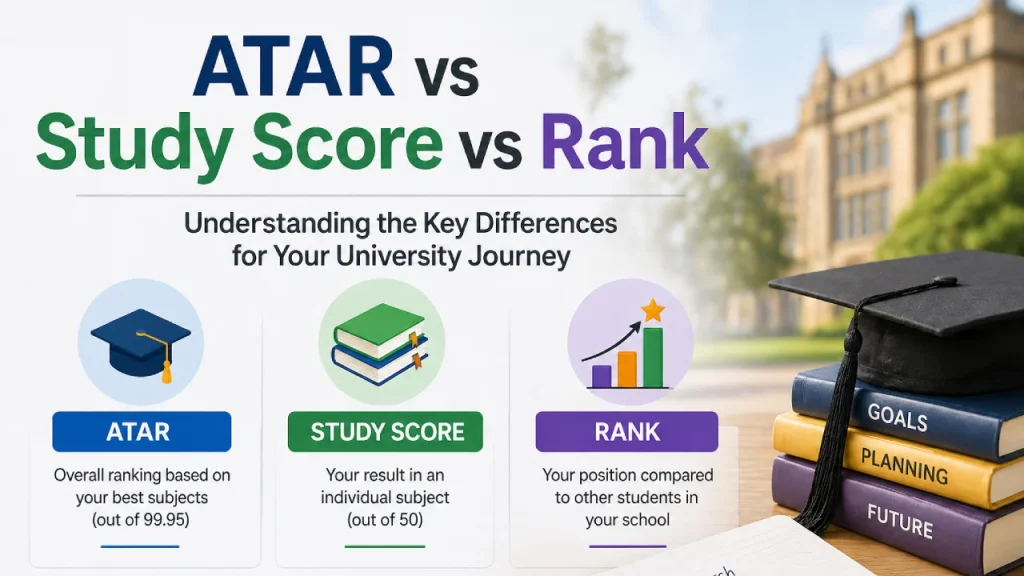
A Study Score is your raw mark in a single subject (e.g., 35 out of 50 in VCE). A Scaled Score is that same study score after being statistically adjusted up or down based on how hard the subject was and how strong the students in it were. An ATAR (Australian Tertiary Admission Rank) is a percentile (0.00 to 99.95) calculated by adding up your scaled scores from your top subjects and comparing your total to every other student in the state. Universities only see your ATAR. They never see your study score or your scaled score.
Why Everyone Confuses These Terms
If you ask a Year 12 student “What did you get?” they might reply “I got a 38.” But what does that mean? Is 38 their study score? Their scaled score? Or are they incorrectly referring to their ATAR as 38 (which would actually be an ATAR of 38.00—a very different thing)?
The confusion happens because all three numbers exist on a continuum. You start with a study score, it gets transformed into a scaled score, and then multiple scaled scores get mashed together to produce an ATAR. Because they are all numbers that represent your academic performance, students naturally treat them as interchangeable. They are not.
While the terminology “Study Score” is specific to Victoria (VCE), the exact same three-tier concept exists in every state. In NSW, it’s your HSC Mark (raw) vs. Scaled Mark vs. ATAR. In Queensland, it’s your Subject Result vs. Scaled Result vs. ATAR. The underlying mathematics is identical.
Your study score and scaled score are intermediate calculations. They are the ingredients that go into the ATAR recipe—but the university never sees the ingredients. They only see the final baked cake (your ATAR). If you want to understand the full recipe from start to finish, read our step-by-step guide on how to calculate the ATAR.
The Study Score (Subject Level)
The study score is the most straightforward of the three numbers. It is a measure of your achievement within a single subject.
- What it measures: How well you demonstrated the learning outcomes for that specific subject.
- Scale: In VCE, it is a number out of 50. In HSC, it’s a mark out of 100.
- Who sees it: You and your school. The TAC sees it briefly during processing, but it is not reported to universities.
- What it’s based on: A combination of your school-assessed coursework (SACs) and your final external exam mark.
A study score of 30 in VCE means you demonstrated a “very good” understanding of the subject content. A 40 means “excellent.” A 50 means you demonstrated perfect mastery (this is exceptionally rare).
You can use a study score calculator to estimate what your raw marks might look like once they are combined into a single study score for each subject.
The Scaled Score (Adjusted Level)
This is where things get complex—and where the most damaging misconceptions live. After you receive your study score for a subject, the TAC applies scaling to it.
Scaling is a statistical adjustment that accounts for the fact that some subjects are inherently more competitive than others. If you get a 35 in Specialist Mathematics (taken by the state’s top students) and a 35 in a much less competitive subject, those two 35s do not represent equal academic achievement. Scaling corrects this imbalance.
Scales UP (Score Increases)
- Specialist Mathematics
- Mathematical Methods
- Physics
- Chemistry
- Literature / English Language
- Why? Taken by highly competitive cohorts.
Scales DOWN (Score Decreases)
- Standard English
- Business Management
- Health & Human Development
- Physical Education
- Why? The overall academic performance of the cohort is closer to the state average, so scores are adjusted down to maintain fairness relative to high-scaling subjects.
Students often panic when they see their study score drop during scaling. A raw 38 becoming a scaled 34 feels like a penalty. It is not. It simply means that a 38 in that subject represents the same level of academic achievement as a 34 in a harder subject. You haven’t lost anything—your score has just been translated into a common currency. For the deep mathematics behind this, read our complete VCE scaling guide.
The ATAR / Rank (State Level)
The ATAR—Australian Tertiary Admission Rank—is the final output of the entire calculation process. It is not a score out of 100. It is a percentile rank. As we explain in our foundational guide on what the ATAR is in Australia, an ATAR of 80.00 means you performed better than 80% of the state.
Here is exactly how the ATAR is derived from your scaled scores:
Your English scaled score plus your next three highest scaled scores. (In VCE, your 5th and 6th subjects contribute 10% each).
Add those scaled scores together. This creates your Aggregate (a single number, usually somewhere between 100 and 210).
The TAC takes every student’s aggregate, sorts them from highest to lowest, and assigns a percentile. The highest aggregate gets 99.95. Your position on that list is your ATAR.
To estimate what your scaled scores might turn into, you can use a dedicated VCE ATAR calculator that applies the previous year’s official scaling data to your predicted raw marks.
The Classroom Analogy: Making It Make Sense
Imagine you are in a school with three classes running simultaneously:
1. Study Score = Your Class Grade
You scored 85% on your Maths test. That grade only makes sense within the context of that specific Maths class. It doesn’t say anything about how you compare to the Physics class next door.
2. Scaled Score = The Difficulty Curve
The teacher realizes the Maths test was much harder than the Art test. A 85% in Maths is adjusted up to a “fair value” of 92%, so it can be fairly compared to the Art score.
3. ATAR = Your Rank in the Entire School
The principal takes all the “fair value” scores from every class across every subject for every student in the school. They line everyone up from highest to lowest. Your position in that line is your rank. If you are above 90% of the school, your rank is 90.00. That is your ATAR—but applied to the entire state, not just one school.
Visual Transformation Table
Here is a real-world example of how a single subject transforms through the three stages. Notice how a “good” raw score in a low-scaling subject can actually result in a lower contribution to your ATAR than a “good” raw score in a high-scaling subject.
| Subject | Study Score (Raw) | Scaled Score (Adjusted) | Impact on ATAR Aggregate |
|---|---|---|---|
| Specialist Maths | 30 | 36 | +6 points (Strong) |
| Mathematical Methods | 34 | 38 | +4 points (Good) |
| English Language | 36 | 38 | +2 points (Slight boost) |
| Biology | 36 | 34 | -2 points (Slight drag) |
| Business Management | 38 | 32 | -6 points (Significant drag) |
The student scored a 38 raw in Business Management but it contributed only 32 to their ATAR. The student scored a 34 raw in Specialist Maths but it contributed 36 to their ATAR. The “lower” raw score in the harder subject was actually worth more. This is why subject selection is a strategic game. If you want to see how this plays out with your specific subjects, use our main ATAR calculator.
How This Impacts Your Subject Strategy
Understanding the difference between study scores, scaled scores, and ATARs is not just academic knowledge—it has a direct, measurable impact on the subjects you should choose in Year 11 and 12.
A 30 raw in Specialist Maths (which might scale to 36) is almost always better for your ATAR than a 38 raw in a low-scaling subject (which might scale down to 32).
Scaling cannot rescue a terrible raw score. A raw 20 in Specialist Maths will scale up, but it will still result in a low scaled score that drags your aggregate down. You must be capable of achieving a solid raw score before scaling can help you.
Because English is compulsory and must count as a primary subject, your scaled English score has an outsized impact on your ATAR. Choosing a high-scaling English (Literature, English Language) over Standard English is one of the highest-leverage decisions you can make. For a full breakdown of optimal subject combinations, see our guide to the best subjects for a high ATAR score in Australia.