Minimum ATAR for Universities in Australia
The real minimum entry thresholds for every university tier—from Group of Eight elites to the most accessible regional campuses.
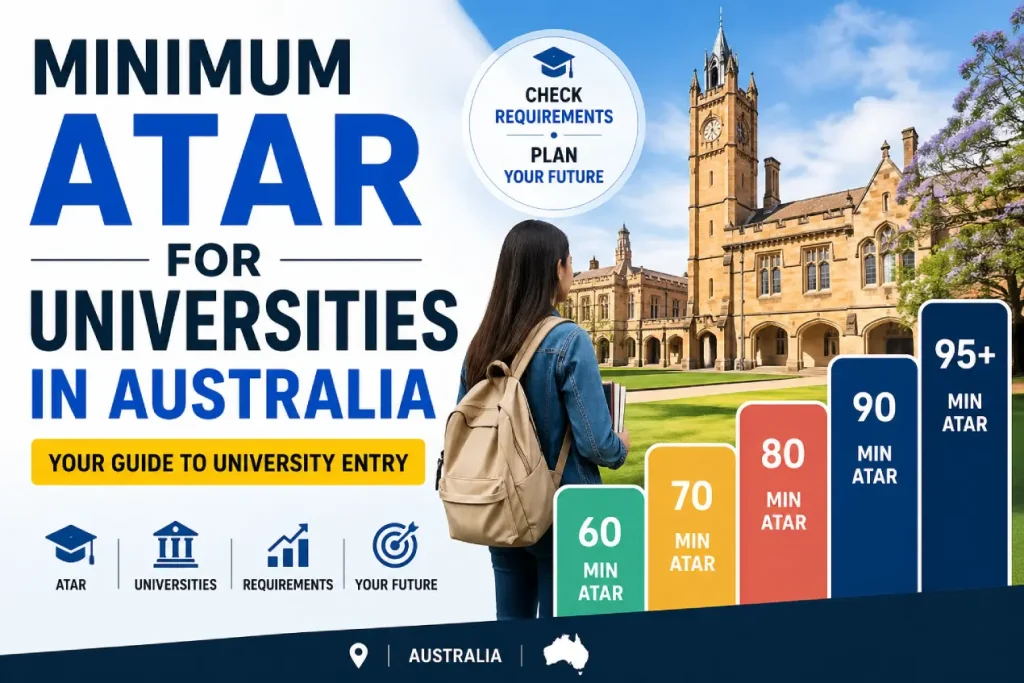
The absolute minimum ATAR to get into an Australian university is approximately 55.00 (for select degrees at universities like Federation University or Charles Sturt). However, understanding university minimums requires knowing the difference between a “guaranteed entry” ATAR and a “Clearly In” ATAR. The “Clearly In” ATAR is the score of the lowest-ranked student who received an offer in the previous year—it is not a guarantee. For the prestigious Group of Eight (Go8) universities, the minimum ATARs for broad degrees sit between 70.00 and 80.00, but competitive courses like Commerce or Engineering usually require 85.00 to 95.00+.
Uni Minimum
Minimum Average
(Equity Schemes)
Is Not a Promise
The “Clearly In” Illusion Explained
When you look up a course on a university website and see “Minimum ATAR: 75.00,” it is natural to think, “If I get a 75, I’m in.” This is the single most dangerous assumption you can make during Year 12.
That number is the “Clearly In” ATAR. It represents the ATAR of the lowest-ranked student who was made an offer for that course in the previous year’s main admission round. It is a historical data point, not a legal guarantee.
Here is why this distinction matters:
What a “Clearly In” ATAR Is
- A historical benchmark based on last year’s offers.
- The score of the weakest student who received an offer.
- It can and does rise or fall every year based on cohort demand.
- If 500 people apply for 100 places and 50 of them have ATARs above 85, the Clearly In will be around 85—regardless of whether the published minimum is 70.
What a “Guaranteed Entry” ATAR Is
- There is technically no such thing for most courses.
- Even if a university publishes a “guaranteed” minimum, it usually comes with strict prerequisite conditions.
- To be truly safe, you should aim for an ATAR 5 points above the published minimum.
Treat the published minimum as the floor, not the target. If a course lists a minimum of 75, aim for 80. If a course lists 65, aim for 70. This 5-point buffer absorbs the annual fluctuations in course demand that routinely destroy the plans of students who aimed exactly for the minimum.
Group of Eight (Go8) Minimum ATARs
The Group of Eight represents Australia’s most prestigious, research-intensive universities (University of Sydney, University of Melbourne, UNSW, ANU, Monash, UQ, UWA, University of Adelaide). Getting into a Go8 university is considered the gold standard of Australian academic achievement—but the minimum ATARs might surprise you for non-competitive degrees.
| University | Degree Example | Publish. Min ATAR | Realistic Target |
|---|---|---|---|
| Uni of Melbourne | Bachelor of Arts | ~80.00 | 85–88 |
| Uni of Sydney | Bachelor of Science | ~80.00 | 85–88 |
| UNSW | Bachelor of Arts | ~77.00 | 82–85 |
| ANU | Bachelor of Arts | ~80.00 | 85–88 |
| Monash | Bachelor of Science | ~80.00 | 85–88 |
| UQ | Bachelor of Arts | ~72.00 | 77–80 |
| UWA | Bachelor of Arts | ~75.00 | 80–83 |
| Uni of Adelaide | Bachelor of Health Sciences | ~70.00 | 75–78 |
The table above shows broad, accessible degrees. If you want Law at Melbourne or Sydney (95–99+), Engineering at UNSW or Monash (92–98+), or Commerce at any Go8 (85–95+), the minimums jump dramatically. Those courses sit in the top 5–10% of the state, not the bottom 20%.
The 60–79 ATAR Sweet Spot (Mid-Tier Universities)
For the vast majority of students, the most realistic target zone is between 60.00 and 79.00. This ATAR range unlocks a massive array of excellent degrees at universities like Deakin, Griffith, Macquarie, RMIT, UOW, Western Sydney, La Trobe, Flinders, and Curtin.
| University | Degree Example | Publish. Min ATAR | Tier |
|---|---|---|---|
| Deakin | Bachelor of Commerce | ~55.00 | Accessible |
| Macquarie | Bachelor of Arts | ~65.00 | Accessible |
| RMIT | Bachelor of Design | ~65.00 | Accessible |
| Griffith | Bachelor of Business | ~70.00 | Mid-Tier |
| UOW | Bachelor of Science | ~75.00 | Mid-Tier |
| Flinders | Bachelor of Health Sciences | ~70.00 | Mid-Tier |
| Curtin | Bachelor of Arts | ~70.00 | |
| Western Sydney Uni | Bachelor of Criminal Justice | ~65.00 | |
| La Trobe | Bachelor of Arts | ~60.00 | Accessible |
This ATAR range is large enough that you don’t need to be in the top 5% of the state. You can afford to take subjects you enjoy rather than only subjects that scale well. If you are sitting in the 65–75 range and want to push toward 80, the most efficient strategy is swapping one of your moderate-scaling subjects for a high-scaling one. To see exactly how this works, read our guide on how subject scaling works in Australia.
The 50–59 ATAR Accessible Tier (Regional & Federation)
If your predicted ATAR is in the 50s, you are not locked out of university. There is a specific tier of universities and degrees designed explicitly to maximise access. The lowest minimum ATARs in the country are found at Federation University, Charles Sturt University, and select regional campuses of larger universities.
| University | Degree Example | Publish. Min ATAR | Notes |
|---|---|---|---|
| Federation University | Bachelor of Arts | ~55.00 | One of the lowest minimum ATARs in the country. Online and multiple campuses. |
| Charles Sturt University | Bachelor of Arts | ~55.00 | Very accessible. Strong regional presence in NSW/VIC. |
| Southern Cross University | Bachelor of Arts | ~60.00 | Low entry, flexible delivery options. |
| Uni of New England (UNE) | Bachelor of Arts | ~55.00 | >Excellent online options. Very accessible.|
| Uni of Southern Queensland (UniSQ) | Bachelor of Arts | ~55.00 | Low entry threshold. Strong online and regional focus. |
| Uni of Canberra (Canberra campus) | Bachelor of Arts | ~60.00 | Accessible entry into the ACT’s largest university. |
Many incredibly successful people started with an ATAR in this range. If your score lands here, you can access excellent degrees that lead directly to careers in business, teaching, IT, social work, and communications. For more ideas on what you can study with a lower ATAR, see our guide to the best courses you can study with a low ATAR.
Adjustment Factors: The Hidden Minimum Reducer
Here is the secret weapon that thousands of students fail to use: if your raw ATAR falls below a university’s published minimum, adjustment factors can legally and legitimately increase it by up to 10 points, depending on your circumstances.
Regional Bonus Points
- Applying to a regional campus can add 2 to 5 points to your ATAR.
- Example: Deakin gives up to 5 points for Geelong/Warrnambool applicants.
- UQ gives bonus points for their regional medical pathway.
- USyd and UNSW offer adjustment for rural students.
SEAS (Special Entry Access Schemes)
- Financial hardship can add 2 to 5 points.
- Disrupted schooling (illness, family crisis) can add significant weight.
- Disability or medical conditions can add points.
- Indigenous status provides substantial adjustments at most universities.
You must apply through your state’s TAC during the standard application period (usually when you register for courses). Do not wait until after you get your ATAR—by then, it is too late. Check your TAC’s SEAS/Access scheme deadlines, which often close in October or November, before your final exams even begin. Learn more about how the system processes your raw marks in our guide on how the ATAR is calculated step by step.
What to Do If You Miss the Minimum ATAR
Missing a minimum ATAR feels devastating in December, but it is far from the end of your university ambitions. The Australian university system is explicitly designed with multiple back doors.
Many universities run 2nd and 3rd offer rounds in January and February. Cutoffs routinely drop by 2–5 points in these later rounds as students decline their initial offers, freeing up places. ATARs released in mid-December often trigger a cascade of shifting preferences.
TAFE diplomas, foundation years, and enabling programs can bypass the ATAR entirely. Completing a one-year Diploma of Commerce, for example, can guarantee entry into the second year of a Bachelor of Commerce at many universities. For a complete breakdown of every option available to you, read our guide on alternative pathways to university in Australia.
Accept an offer into a related lower-ATAR degree (e.g., a Diploma or Associate Degree in Health Science), achieve a high GPA in your first year, and then apply to internally transfer into the competitive degree you originally wanted. Once you are in the university system, your ATAR no longer matters.
State-by-State Nuances
While ATARs are nationally standardised, the distribution of minimum thresholds varies significantly by state. Some states have specific statutory requirements that affect minimums.
Victoria (VTAC)
- Very accessible minimums at regional campuses (Federation, La Trobe).
- Melbourne Model requires applying for a broad degree first (no direct BPsych).
- TAFE-to-uni articulation pathways are very strong in VIC.
Queensland (QTAC)
- Recently transitioned from OP to ATAR, so historical data is limited.
- QUT, UQ, and Griffith still have relatively high minimums (75–99) for their flagship programs.
- For a deep dive into how Queensland’s system works, see our guide on QCE ATAR requirements for top universities.
Universities explicitly state that published ATARs are indicative. They can and do change. A course that was 65 last year could be 70 this year, or vice versa. Always check the most current VTAC, UAC, or QTAC course search tool when finalising your preferences.
Frequently Asked Questions
Key Takeaways
- The absolute minimum ATAR for university entry in Australia is ~55.00. This is found at universities like Federation and Charles Sturt for broad arts degrees.
- Go8 minimums range from 70 to 80 for accessible degrees like Arts and Science, but competitive degrees like Law and Commerce require 85 to 95+. li>The “Clearly In” ATAR is not a guarantee. It is a historical benchmark. Always aim 5 points above it to absorb annual demand fluctuations.
- Adjustment factors can reduce your effective minimum. SEAS, regional bonuses, and equity schemes can legally add up to 10 points to your ATAR. But you must apply before December.
- Missing a minimum ATAR is not the end. Subsequent offer rounds, TAFE-to-uni pathways, and internal transfers are all designed to catch students who fall short on results day.
- Choose your target course first, then work backward. Don’t choose subjects purely for ATAR; choose them because they satisfy the prerequisites for the course you actually want to study, whether that’s Psychology, Nursing, or Dentistry.